 By Maya Reed, Editor
Reviewed & updated September 2026 · Researched, AI-assisted & human-reviewed
Educational information only — not medical advice. Learn more
This article is for general information and is not medical advice.
Walk into any gym and you'll see people working hard with no real plan — random machines, the same three exercises, no progress for months. A good routine fixes that. It tells you what to do, when, and how to get a little better each week, so your effort actually turns into results.
The good news: building a solid routine isn't complicated. You don't need a spreadsheet or a coach. This guide walks you through it step by step, then hands you a ready-made beginner template you can start this week.
 What this guide coversCurated by Maya · 6 min read
- Step 1: Pick your goal
- Step 2: Choose how many days you’ll train
- Step 3: Cover the key movement patterns
- Step 4: Set sets, reps, and rest
- Step 5: Progress over time (the part that matters most)
- Step 6: Add cardio and recovery
- A ready-made beginner routine (3 days/week)
- The bottom line
- Related articles
- Further reading & trusted sources
Step 1: Pick your goal
Your goal shapes everything. Most people want one of these:
- Build muscle / get toned — focus on resistance training with progressive overload.
- Lose fat — resistance training to keep muscle, plus activity and a calorie deficit (the diet does most of the work — see how to lose fat).
- Get stronger — resistance training with heavier loads and lower reps.
- General health & fitness — a mix of strength, cardio, and mobility.
For most beginners, resistance training is the backbone of all of these. Build the strength habit first.
Step 2: Choose how many days you'll train
Be honest about your schedule — the best plan is one you'll actually follow.
- 2 days/week: Two full-body workouts. Surprisingly effective for beginners.
- 3 days/week (the sweet spot): Three full-body sessions on non-consecutive days (e.g. Mon/Wed/Fri).
- 4 days/week: An "upper/lower" split — two upper-body days and two lower-body days.
Beginners do best with full-body workouts 3 times a week. They hit each muscle often, are forgiving if you miss a day, and drive fast early progress.
Step 3: Cover the key movement patterns
A balanced routine trains every major pattern rather than just "chest and arms." Build each workout from these:
- Squat (squats, goblet squats, leg press) — legs
- Hinge (deadlifts, hip thrusts, kettlebell swings) — glutes, hamstrings
- Push (push-ups, bench press, shoulder press) — chest, shoulders, triceps
- Pull (rows, lat pulldowns, assisted pull-ups) — back, biceps
- Carry / core (planks, suitcase carries, dead bugs) — core, stability
Hit a squat, a hinge, a push, a pull, and some core each session and you've covered your whole body.
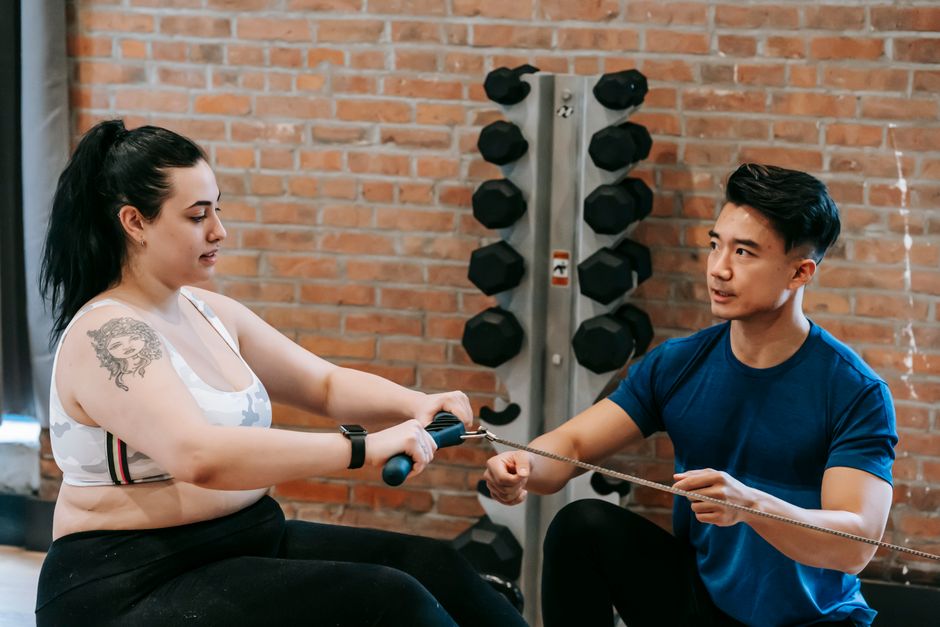
Step 4: Set sets, reps, and rest
For building muscle and general fitness, this works well:
- Sets: 2–4 per exercise.
- Reps: 8–15 for most exercises.
- Rest: 60–120 seconds between sets (longer for heavy lifts).
- Effort: Stop each set 1–3 reps before failure — close to hard, but with good form.
Start with the lower end (e.g. 2 sets) and add volume as you adapt.
Step 5: Progress over time (the part that matters most)
This is the secret the random-routine crowd misses: progressive overload. To keep improving, your workouts must gradually get harder. Each week, try to do a little more than last time:
- Add a rep or two to a set.
- Add a small amount of weight when you hit the top of your rep range.
- Add a set.
- Improve your form or control.
Keep a simple log (notes app or notebook) of what you lifted. Beating last week's numbers — even slightly — is how you guarantee progress.
Step 6: Add cardio and recovery
- Cardio: 2–3 sessions a week supports heart health and fat loss. Walking counts — see walking for weight loss and the best cardio for fat loss.
- Recovery: Muscles grow during rest, not during the workout. Take rest days, prioritise sleep, and eat enough protein. See why sleep is the secret weapon of fitness.
A ready-made beginner routine (3 days/week)
Do this full-body workout 3 times a week on non-consecutive days. 2–3 sets each, 8–12 reps:
- Goblet squat (legs)
- Push-up or dumbbell bench press (push)
- Dumbbell row (pull)
- Romanian deadlift or hip thrust (hinge)
- Shoulder press (push)
- Plank — 3 × 30–45 seconds (core)
Warm up for 5 minutes first, log your numbers, and aim to beat them slightly each week. After 8–12 weeks, increase the weights or move to an upper/lower split.
Frequently asked questions
How many days a week should a beginner work out?
Three full-body sessions a week on non-consecutive days is the sweet spot for most beginners — enough to drive progress, with built-in recovery. Even two days a week produces good results if you're consistent.
How long should a workout be?
Most effective beginner workouts take 30–60 minutes including a warm-up. Quality and consistency matter far more than length — a focused 40-minute session beats a distracted 90-minute one.
Should beginners do full-body or a split routine?
Full-body workouts are ideal for beginners because they train each muscle several times a week and are forgiving if you miss a session. Splits become useful later, once you're training 4+ days a week.
How do I know if my routine is working?
You should be able to do a little more over time — more reps, more weight, or better form — and see gradual changes over weeks. If you log your workouts and the numbers climb, it's working. If nothing changes for weeks, add progression or check your nutrition.
The bottom line
A great routine is simple: pick a goal, train 3 full-body days a week, cover the main movement patterns, and add a little each week. Track your workouts, eat and sleep enough to recover, and let consistency do the heavy lifting. Start with the template above and adjust as you grow.
Next, learn how to build muscle as a beginner or try our full-body dumbbell workout.
Read next


Related articles
- Home Gym Setup Ideas for Beginners
- Pilates for Beginners: The Complete Guide to Starting at Home
- The Best Glute Workout at Home (No Equipment Needed)
- HIIT Workouts for Beginners: A Complete Guide
- How to Warm Up Before a Workout
- How to Improve Your Flexibility: A Beginner’s Guide
Further reading & trusted sources
The part that actually matters
A routine you’ll repeat beats the optimal one you dread — pick something that fits your week and lets you progress. Most beginners quit a ‘perfect’ plan that was simply too long or too frequent to keep up.
Maya’s editorial obsession is the gap between fitness hype and what the evidence actually shows — she’d rather hand you one boring habit that works than ten exciting ones that don’t. She builds FitNourish’s guides from mainstream, well-established sources (the CDC, the NHS, Mayo Clinic, and peer-reviewed research) and has a human review every one for accuracy before it publishes. She and the team are dedicated fitness enthusiasts and researchers, not doctors, so everything here is general information rather than medical advice. AI tools help with the research and drafting; the fact-checking and judgement are human.