 By Maya Reed, Editor
Reviewed & updated September 2026 · Researched, AI-assisted & human-reviewed
Educational information only — not medical advice. Learn more
Twenty minutes of HIIT can leave you breathing harder than an hour on the treadmill — that’s the appeal, and also the trap. Push too hard too soon and you’ll dread it within a week. At the right intensity, though, short bursts of effort are a remarkably fast way to build fitness when time is tight. Here’s how a beginner starts without burning out.
This article is for general fitness information only and is not a substitute for medical advice. If you have any health conditions or injuries, consult a qualified healthcare professional before starting a new exercise program.
 On this pageCurated by Maya · 8 min read
- What Exactly Is HIIT?
- Why HIIT Is Perfect for Beginners
- The Science Behind Why HIIT Works
- A Beginner HIIT Workout (No Equipment Needed)
- The Most Common Beginner Mistakes
- How to Progress Your HIIT Over Time
- HIIT vs. Steady-State Cardio: Which Should You Do?
- Equipment That Can Elevate Your HIIT (Optional)
- The Takeaway
- Related articles
- Further reading & trusted sources
What Exactly Is HIIT?
HIIT stands for High-Intensity Interval Training. The concept is elegantly simple: alternate between short bursts of all-out effort and brief recovery periods. A classic structure might be 40 seconds of hard work followed by 20 seconds of rest, repeated for 8–10 rounds.
What makes HIIT different from steady-state cardio is the intensity. During your "on" intervals, you should be working at roughly 80–95% of your maximum effort. That's the key that unlocks HIIT's benefits — pushing your cardiovascular and muscular systems hard, then letting them partially recover before going again.
The result is a training effect called EPOC (Excess Post-Exercise Oxygen Consumption), sometimes called the "afterburn effect." Your body continues burning extra calories for hours after the workout ends as it works to restore itself to baseline.
Why HIIT Is Perfect for Beginners
Counterintuitively, HIIT can be very beginner-friendly. Here's why:
The sessions are short. Most effective HIIT workouts run 15–25 minutes. If you only have half an hour, HIIT delivers far more bang per minute than a casual 30-minute jog.
You control the intensity. "High intensity" is relative to YOU. A beginner working at 85% of their personal max gets the same training stimulus as an athlete working at 85% of theirs. No experience required.
The rest periods are built in. Unlike running for 30 straight minutes, HIIT builds recovery into the structure. This makes it accessible for people who aren't yet conditioned for sustained cardio.
It requires zero equipment. Bodyweight HIIT — jumping jacks, mountain climbers, burpees, squat jumps — is just as effective as any machine-based version.
The Science Behind Why HIIT Works
During high-intensity intervals, your body depletes its fast-twitch muscle fibers and pushes into anaerobic territory. This creates a significant metabolic demand. To recover, your body has to work hard to:
- Clear lactate from the muscles
- Replenish glycogen stores
- Repair microtears in muscle tissue
- Regulate core temperature
All of this takes energy — which means calories burned long after you've showered. Studies have shown HIIT can elevate metabolic rate for up to 24 hours post-workout. That's a meaningful advantage if fat loss is a goal.
HIIT also improves VO2 max (your body's maximum oxygen uptake capacity) faster than steady-state cardio in many studies. Higher VO2 max correlates strongly with longevity and cardiovascular health.
A Beginner HIIT Workout (No Equipment Needed)
This 20-minute workout uses a 40-second work / 20-second rest format. Perform 3 rounds with a 60-second break between rounds.
Round structure (5 exercises, back to back):
- Jumping jacks — full body warm-up, gets the heart rate climbing
- Bodyweight squats — lower body power, keep chest tall and knees tracking over toes
- Mountain climbers — core and cardio combo, drive knees to chest alternately at speed
- Push-up variations — full push-ups if you can, knee push-ups if needed, both are valid
- High knees — explosive cardio finisher, pump your arms and drive knees to hip height
Timing:
- Warm-up: 3 minutes of light jogging in place + arm circles + hip circles
- Workout: 3 rounds × 5 exercises × (40s on / 20s off) = ~18 minutes
- Cool-down: 3–5 minutes of static stretching

The Most Common Beginner Mistakes
Going too hard too soon. The biggest HIIT mistake is sprinting into week one at maximum intensity. Your connective tissue (tendons, ligaments) adapts more slowly than your cardiovascular system. Build intensity gradually over the first 3–4 weeks.
Skipping the warm-up. Jumping straight from the couch into burpees is a recipe for a pulled muscle. Five minutes of dynamic movement — leg swings, hip circles, light jogging — makes a real difference.
Training HIIT every day. HIIT is demanding. Most beginners should do no more than 2–3 sessions per week with full rest days between. Overtraining leads to fatigue, injury, and plateaus — the opposite of progress.
Sacrificing form for speed. Speed is irrelevant if your squat looks like a crumple or your push-up is a worm impression. Perfect the movements at moderate intensity first, then layer on the effort.
Not fueling properly. HIIT depletes glycogen. If you're training fasted and feeling dizzy or weak, eat a small carb-protein snack 60–90 minutes before. Afterward, a recovery meal with protein within 30–60 minutes accelerates repair.
How to Progress Your HIIT Over Time
Beginners plateau quickly if the stimulus doesn't change. Here's a simple 6-week progression:
- Weeks 1–2: 2 sessions/week, 2 rounds, 30s work / 30s rest
- Weeks 3–4: 2–3 sessions/week, 3 rounds, 40s work / 20s rest
- Weeks 5–6: 3 sessions/week, 4 rounds, 45s work / 15s rest
As you get fitter, you can also progress the exercises themselves — swapping regular squats for jump squats, adding a plyometric push-up, or replacing high knees with sprint intervals.
HIIT vs. Steady-State Cardio: Which Should You Do?
This is a false choice. Both have value.
HIIT is better for: time efficiency, afterburn effect, improving VO2 max, variety, and breaking through plateaus.
Steady-state cardio is better for: active recovery, building aerobic base, lower injury risk, and longer training sessions.
Most well-rounded fitness programs include both. A good weekly structure for a beginner might be 2 HIIT sessions, 1–2 walks or easy jogs, and 2 strength training sessions.
Equipment That Can Elevate Your HIIT (Optional)
HIIT is free by design, but a few additions can add variety:
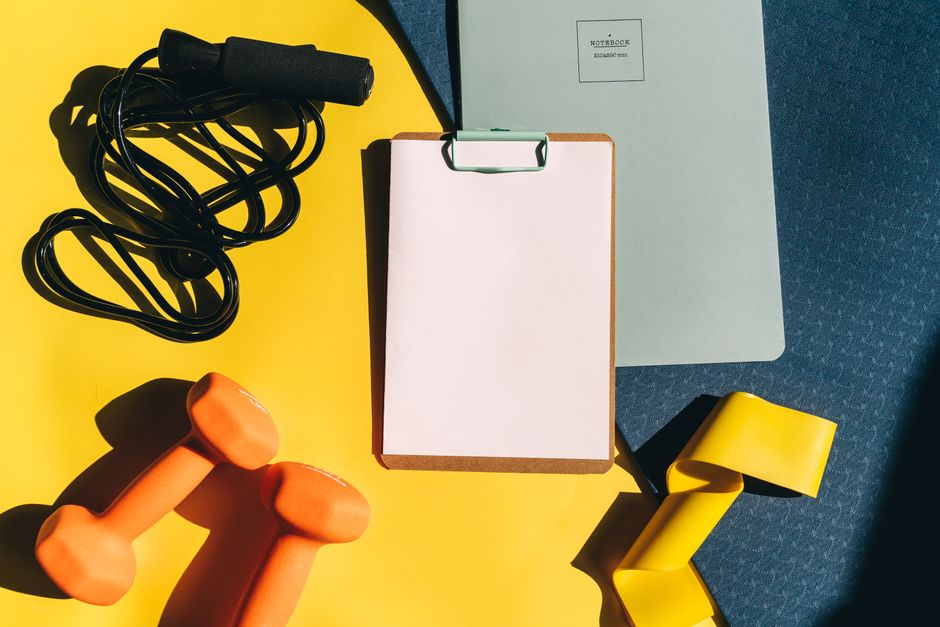
- Jump rope: One of the most effective HIIT tools in existence. 30-second sprint intervals with a jump rope are brutally effective.
- Resistance bands: Add bands to squats or use them for lateral walks between HIIT rounds for glute emphasis.
- Gymboss or interval timer app: Takes the mental math out of timing so you can focus on working hard.
- Agility ladder: For footwork-focused HIIT drills that also build coordination.
None of these are necessary, but they keep workouts fresh over months of training.
The Takeaway
HIIT is one of the most efficient fitness tools available, and its barrier to entry is essentially zero. No gym, no equipment, no experience required. Start with two sessions per week, keep your form honest, respect the rest days, and build intensity gradually over 6–8 weeks. The combination of in-workout calorie burn and post-workout EPOC makes it uniquely effective — and the short sessions mean consistency is actually achievable.
Start simple. Work hard during the intervals. Rest fully between them. Repeat twice a week. That's the whole system.
Frequently Asked Questions
How many times a week should a beginner do HIIT?
Start with 2 sessions per week with at least one full rest day between them. Your body needs recovery time to adapt, especially in the first month. Add a third session only once the first two feel manageable.
Is HIIT safe if I'm out of shape?
Yes, with appropriate modifications. Scale intensity and exercise difficulty to YOUR current level. Low-impact HIIT (swapping jumping jacks for step-jacks, for example) delivers excellent results for people who need to protect joints.
How soon will I see results from HIIT?
Most beginners notice improved cardio endurance within 2–3 weeks. Visible body composition changes typically take 4–8 weeks of consistent training combined with a supportive diet.
Can I do HIIT and strength training on the same day?
You can, but it's better to prioritize one. If strength is the goal, do weights first while fresh and add a short HIIT finisher. If cardio is the focus, reverse it. Avoid doing maximum-effort HIIT and heavy leg day back to back.
Read next

Related articles
- How to Warm Up Before a Workout
- The Best No-Equipment Bodyweight Workout for Beginners
- The Best Cardio for Fat Loss (And How Much You Actually Need)
- Yoga for Beginners: A Simple Guide to Getting Started
- The Best Full-Body Dumbbell Workout (For Home or Gym)
- How to Get Abs: An Honest Guide to a Six-Pack
Further reading & trusted sources
What to actually expect
HIIT is effective but easy to overdo — two or three short sessions a week is plenty, and more isn’t better with intervals. Beginners burn out doing it daily; the hard work needs recovery to pay off.
Maya’s editorial obsession is the gap between fitness hype and what the evidence actually shows — she’d rather hand you one boring habit that works than ten exciting ones that don’t. She builds FitNourish’s guides from mainstream, well-established sources (the CDC, the NHS, Mayo Clinic, and peer-reviewed research) and has a human review every one for accuracy before it publishes. She and the team are dedicated fitness enthusiasts and researchers, not doctors, so everything here is general information rather than medical advice. AI tools help with the research and drafting; the fact-checking and judgement are human.