 By Maya Reed, Editor
Reviewed & updated September 2026 · Researched, AI-assisted & human-reviewed
Educational information only — not medical advice. Learn more
The bench press is one of the most requested lifts at any gym, and also one of the most commonly done wrong — bouncing bars off the chest, flared elbows, and heels that never touch the floor are all fixable with a few form cues. This guide breaks the lift down step by step so you can press heavier, safer, and with less shoulder strain.
This is general fitness information, not medical advice. Check with a doctor before starting a new strength program, especially if you have an existing shoulder, elbow, or chest injury.
 In this guideCurated by Maya · 7 min read
Why bench press form matters more than the number on the bar
Bench press is a compound push movement that trains the chest, shoulders, and triceps at once, which is exactly why sloppy form causes problems — three joints are working together, and a breakdown at any one of them (usually the shoulder) shows up as pain within a few sessions. Good form isn't about looking pretty; it's what lets you press consistently for years instead of nursing a cranky shoulder every time you push volume.
Setting up on the bench
- Eyes under the bar. Lie back so your eyes are roughly under the bar, not your chest — this puts your shoulders in the right position to unrack without straining forward.
- Plant your feet flat on the floor, not up on the bench or on your toes. A stable base through your legs lets you drive force into the bench instead of losing tension.
- Pull your shoulder blades together and down, like you're tucking them into your back pockets, and keep that squeeze for the entire set. This creates a stable "shelf" for the bar and protects the front of the shoulder.
- Keep a natural arch in your lower back — not an exaggerated one, just enough that your glutes stay lightly in contact with the bench and your lower back isn't jammed flat.
The grip and unrack
Grip the bar slightly wider than shoulder width — as a rough guide, your forearms should be roughly vertical when the bar touches your chest. Too wide overloads the shoulders; too narrow shifts the work onto the triceps and shortens your range of motion in an awkward way.
Unrack the bar by straightening your arms and shifting it over your shoulders (not your chest) before starting the descent. Take a breath and brace your core before the first rep — this isn't optional at heavier weights, since a braced trunk is what keeps the bar path stable.
The descent (eccentric)
Lower the bar under control, aiming for your lower chest or upper abdomen rather than your collarbone — bringing it to the collarbone twists the shoulder into a vulnerable position. Keep your elbows tucked at roughly a 45-degree angle from your torso, not flared out to 90 degrees; flared elbows are the single biggest cause of shoulder pain in benching. The bar should touch (or nearly touch) your chest lightly — never bounce it off your sternum to generate momentum.
The press (concentric)
Drive the bar back up in a slight arc, pressing it back toward your shoulders rather than straight up and over your face. Keep your feet planted and your upper back tight against the bench throughout — some lifters lightly drive through their legs ("leg drive") to add stability, but this takes practice and isn't necessary for beginners. Exhale as you press through the sticking point, and lock out with your elbows extended but not hyperextended.
Common mistakes to fix
- Flaring the elbows to 90 degrees — tuck to roughly 45 degrees to protect the shoulder joint.
- Bouncing the bar off the chest — control the descent and pause briefly at the bottom instead.
- Lifting the hips or feet off the bench — this signals the weight is too heavy for your current control; drop the load and rebuild.
- Flat feet placed too far forward or up on toes — keep feet flat and roughly under or slightly behind the knees for a stable base.
- Uneven bar path — if the bar drifts to one side, it's often a sign one side is doing more work; slow the tempo down and film yourself from the front to check.
How to build up safely as a beginner
Start with just the empty barbell (or dumbbells, which are more forgiving on the shoulders while you learn the movement) for several sessions until the form cues above feel automatic. Add weight in small increments — 5 to 10 pounds per side at most — and only once you can complete every rep with clean form. If you train alone, keep the weight conservative enough that you can safely lower the bar to your chest and roll it off if you fail a rep; using a spotter or a rack with safety bars removes this risk entirely and lets you push closer to your limit.
Bench press variations worth knowing
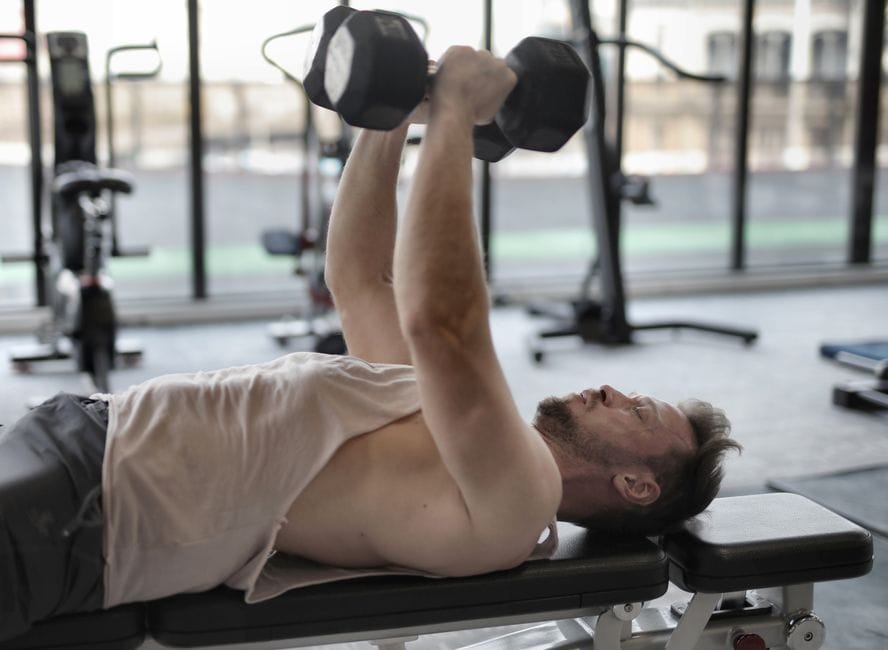
- Dumbbell bench press — trains each side independently, which helps correct strength imbalances and is often gentler on the shoulders because your hands aren't locked into a fixed bar path.
- Incline bench press — bench set at a 15-30 degree angle, shifting more emphasis to the upper chest and front shoulder.
- Close-grip bench press — hands set closer than shoulder width, shifting more of the work onto the triceps.
- Floor press — performed lying on the floor instead of a bench, which limits the range of motion and can be a useful, lower-strain option while rehabbing a shoulder.
The takeaway
A safe, effective bench press comes down to a stable setup (feet planted, shoulder blades pinned), a controlled descent to the lower chest with elbows tucked around 45 degrees, and pressing back up without bouncing or arching excessively. Master those basics with light weight before chasing bigger numbers — the lift rewards patience far more than ego.
Frequently asked questions
How wide should my grip be on the bench press?
A good starting point is slightly wider than shoulder width, such that your forearms are roughly vertical when the bar touches your chest. Adjust slightly based on your own shoulder comfort.
Should the bar touch my chest on every rep?
Yes, ideally the bar lightly touches (or comes very close to) your chest for a full range of motion, but it should never bounce off — control the touch and drive back up smoothly.
Is it safe to bench press without a spotter?
It can be, especially with dumbbells (which you can simply drop to the sides) or a rack with properly set safety bars. With a barbell and no safety bars, keep the weight conservative enough that you can always roll it off your chest if a rep fails.
Why do my shoulders hurt after bench pressing?
Shoulder pain after benching is most often caused by flared elbows (aim for roughly 45 degrees) or lowering the bar too high toward the collarbone instead of the lower chest. If pain persists after correcting form, scale back the weight and consider seeing a physical therapist.
Read next

Further reading & trusted sources
What to actually expect
Flared elbows at 90 degrees are the single most common cause of shoulder pain reported by new lifters, and the fix isn’t strength or mobility work — it’s simply tucking to roughly 45 degrees, a cue that resolves most of that pain within a session or two once it actually sticks. A bar path that drifts toward the face rather than back toward the shoulders on the way up is one of the most reliable early signs of a developing muscle imbalance between sides, and it usually shows up in the bar path long before it’s noticeable in a mirror.
Maya’s editorial obsession is the gap between fitness hype and what the evidence actually shows — she’d rather hand you one boring habit that works than ten exciting ones that don’t. She builds FitNourish’s guides from mainstream, well-established sources (the CDC, the NHS, Mayo Clinic, and peer-reviewed research) and has a human review every one for accuracy before it publishes. She and the team are dedicated fitness enthusiasts and researchers, not doctors, so everything here is general information rather than medical advice. AI tools help with the research and drafting; the fact-checking and judgement are human.