 By Maya Reed, Editor
Reviewed & updated September 2026 · Researched, AI-assisted & human-reviewed
Educational information only — not medical advice. Learn more
A cluttered workout space is a workout you skip. If your resistance bands live tangled in a drawer and your dumbbells double as doorstops, you're not alone — most apartment home gyms die from storage neglect, not lack of motivation. The good news: even 50 square feet can become a fully functional, clean training zone with the right storage approach.
This article shares general fitness and organization information. It is not medical or professional advice.
 Quick navigationCurated by Maya · 7 min read
- Why Gym Storage Makes or Breaks Your Consistency
- Wall-Mounted Solutions: The Space Multiplier
- Under-Bed and Furniture Storage
- The Vertical Rack Strategy for Free Weights
- Storing Long or Bulky Items
- Cabinet and Closet Gym Sections
- Cable Management for Any Electrical Equipment
- Labeling and Zone Assignment
- The Takeaway
- Related articles
- Further reading & trusted sources
Why Gym Storage Makes or Breaks Your Consistency
Research on habit formation consistently shows that friction is the enemy of routine. If your jump rope takes 3 minutes to untangle before every session, your brain files the workout as "effortful" before you've done a single rep. Organized storage removes that mental tax.
The goal isn't minimalism for aesthetics — it's zero-friction access. Gear you can grab in 10 seconds is gear you actually use.
Wall-Mounted Solutions: The Space Multiplier
Vertical space is the most underused real estate in a small apartment gym. Wall-mounting lifts everything off the floor and turns dead wall into functional storage.
Pegboards are the classic choice for a reason. A 2×4-foot pegboard panel can hold resistance bands, jump ropes, foam rollers, and small accessories in a fully customizable layout. Add hooks, bins, and shelves as your collection grows. Total cost: under $30 at a hardware store.
Floating shelves work beautifully for stacked dumbbells, kettlebells, and blocks. Install a set of three staggered shelves at different heights — each shelf bearing 50–75 lbs is typically safe with proper stud mounting. Always check your building's wall-mount rules before drilling.
Vertical dumbbell racks exist in floor-standing and wall-bracket versions. The bracket style mounts directly to studs and projects only a few inches from the wall, freeing floor space entirely.
Under-Bed and Furniture Storage
The space under a bed in a studio or bedroom gym is legitimate square footage. A low-profile storage bed or bed risers (+6 inches) creates room for:
- Flat resistance band sets in zip pouches
- Yoga mats in a slim carry bag
- Ankle weights and ab wheel
- Foam roller (if your clearance allows)
Look for rolling storage bins with handles rather than sliding bins — they're far easier to grab mid-warmup without getting on your knees.
Ottomans with interior storage do double duty as seating, weight bench substitute, and gear locker. Store jump ropes, hand grippers, and small accessories inside.
The Vertical Rack Strategy for Free Weights
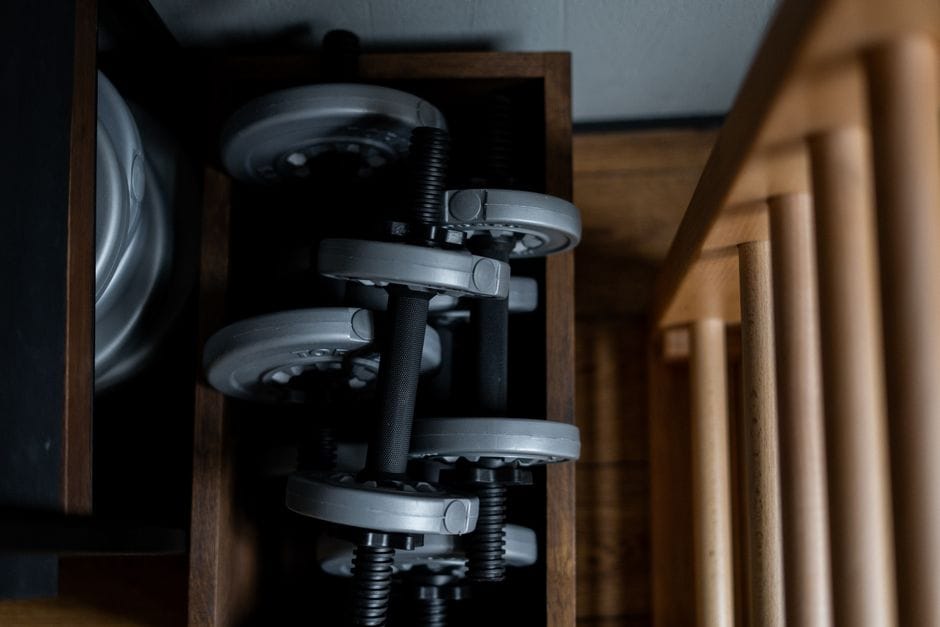
The single most space-efficient free-weight solution for apartments is a tiered A-frame dumbbell rack. A two-tier rack holding 3–5 dumbbell pairs takes roughly a 2×1.5-foot footprint and puts all weights within arm's reach.
If budget is tight, the DIY version works: a wooden step organizer (shelf-style riser) placed in a corner holds dumbbell pairs cleanly. Add rubber shelf liner to prevent rolling.
For kettlebells — stackable on the floor in a corner, fattest to smallest, lined up like Russian nesting dolls. No rack needed; the shape prevents rolling.
Storing Long or Bulky Items
The items that cause the most storage headaches are long-format gear: resistance bands, jump ropes, resistance tubes, and yoga mats. Fixes:
- Over-door hooks: A 5-hook over-door organizer on your closet or bathroom door handles yoga mats, resistance band loops, and jump ropes without any drilling.
- Wall-mounted horizontal rod: A single stainless towel rod (the heavier, longer hardware store version) acts as a mat hanger. Mats roll up and hang off it like towels.
- Labelled mesh bags or zip pouches: Group band resistance levels (light/medium/heavy), label them, and hook all three bags on one pegboard hook. Untangling eliminated.
Cabinet and Closet Gym Sections
If you have an underused closet, claim one shelf or rod section as a dedicated "gym section." Install:
- One shelf for equipment that sits flat (blocks, sliders, ab wheel)
- Hooks on the rod for resistance bands, jump rope, and towels
- A small bin at the bottom for heavier items like ankle weights or a medicine ball
The closet door itself is prime real estate — add an over-door shoe organizer and fill pockets with bands, grippers, chalk bags, and small tools.
Cable Management for Any Electrical Equipment
If you own a cycling bike, rowing machine, or plug-in massage gun, messy power cables become a safety hazard in a small space. Use:
- Velcro cable ties (reusable, $5 for 20)
- Adhesive cable clips along the baseboard
- A small surge protector on a wall plate so everything plugs into one tidy point
Run cables along the wall perimeter, never across the middle of your workout floor.
Labeling and Zone Assignment
Even a small gym benefits from zones. "Zone thinking" helps your brain switch into workout mode and makes it obvious when something is out of place. Suggested zones:
- Strength corner — dumbbells, bands, kettlebell
- Cardio wall — jump rope, skipping timer, mat
- Recovery shelf — foam roller, massage ball, resistance loop set
Simple printed labels or chalk-marker labels on bins take 10 minutes and eliminate the "where did I put my bands?" problem permanently.
The Takeaway
Small-apartment gym storage is solved by going vertical, eliminating floor clutter, and giving every item a specific, labeled home. The most important storage decision isn't what product to buy — it's committing to the system: always return gear to its spot after use. A $20 pegboard with that discipline beats a $200 rack without it. Set your space up once with intention, and you'll never use "I can't find my equipment" as a reason to skip again.
Frequently Asked Questions
What's the cheapest home gym storage solution for an apartment?
A pegboard panel with hooks from a hardware store is the most affordable and versatile option — under $30 total, holds most small gym accessories, and requires only 4 wall anchors.
How do I store dumbbells without a rack in a small apartment?
Place them on a rubber-lined wooden step riser or stair organizer in a corner. Pair them from lightest to heaviest, left to right, so you always grab the right weight instantly.
Can I mount a pegboard in an apartment without losing my security deposit?
Yes — use heavy-duty anchor bolts (not just drywall anchors) in stud locations where required, keep the pegboard trim and neat, and patch holes with spackle when you move. Most landlords accept normal wall wear.
How do I store a yoga mat if I have no closet space?
A wall-mounted horizontal rod (hardware store towel rod) is the cleanest solution. Alternatively, an over-door hook on any interior door works without any drilling.
Read next
Related articles
- 9 Gentle Stretches to Relieve Lower Back Pain
- How to Build a Home Gym on a Budget (Under $200 Setup)
- How to Start Working Out at Home: A Beginner’s Guide
- The Cheapest Way to Build a Home Gym (2026 Update)
- The 5 Pieces You Actually Need for a Home Gym
- “Resistance Bands vs Dumbbells: Which Should You Buy First?”
Further reading & trusted sources
A common mistake to skip
The storage detail that actually predicts whether home gym gear gets used is retrieval time, not tidiness — equipment that takes more than about 30 seconds to get out gets skipped on low-motivation days. Wall hooks and open shelving beat closed bins and under-bed boxes for anything you intend to use several times a week.
Maya’s editorial obsession is the gap between fitness hype and what the evidence actually shows — she’d rather hand you one boring habit that works than ten exciting ones that don’t. She builds FitNourish’s guides from mainstream, well-established sources (the CDC, the NHS, Mayo Clinic, and peer-reviewed research) and has a human review every one for accuracy before it publishes. She and the team are dedicated fitness enthusiasts and researchers, not doctors, so everything here is general information rather than medical advice. AI tools help with the research and drafting; the fact-checking and judgement are human.