 By Maya Reed, Editor
Reviewed & updated September 2026 · Researched, AI-assisted & human-reviewed
Educational information only — not medical advice. Learn more
Building a home gym doesn't have to mean filling a spare room with machines you'll ignore by February. A truly effective setup can fit in a corner, cost under $200, and train every muscle in your body — if you choose the right five pieces. This guide cuts through the noise and tells you exactly what to buy, what to skip, and why less really is more.
This article shares general fitness information for educational purposes. It is not a substitute for advice from a qualified fitness professional or physician. Consult a professional before starting a new exercise program.
 What you’ll find insideCurated by Maya · 10 min read
- Why Most Home Gyms Fail Before They Start
- 1. Adjustable Dumbbells (The Non-Negotiable)
- 2. Resistance Bands (The Most Underrated Tool)
- 3. A Quality Non-Slip Mat (Don’t Cheap Out Here)
- 4. A Pull-Up Bar (The Vertical Dimension)
- 5. A Jump Rope (Cardio That Actually Works)
- What You Don’t Need (Save Your Money)
- How to Arrange Your Space
- A Sample Week With These 5 Tools
- The Takeaway
- Related articles
- Further reading & trusted sources
Why Most Home Gyms Fail Before They Start
The number one reason home gyms end up as expensive coat racks: people try to replicate a commercial gym at home. They buy a treadmill they don't use, a bench that takes up half the room, and a set of fixed dumbbells that covers only one weight range. The smarter approach is to ask: what gives me the most exercise variety per square foot and per dollar?
The five essentials below answer that question. They cover strength, cardio, mobility, and core work — with minimal floor space and maximum versatility.
| # | Highlight | Summary |
|---|---|---|
| 1 | Adjustable Dumbbells (The Non-Negotiable) | If you buy only one thing, make it a pair of adjustable dumbbells. |
| 2 | Resistance Bands (The Most Underrated Tool) | Resistance bands are laughed at by beginners and loved by experienced lifters who actually understand progressive overload. |
| 3 | A Quality Non-Slip Mat (Don’t Cheap Out Here) | A proper exercise mat is one of the most overlooked purchases — until you try to do a plank on hardwood floor and ruin your elbows |
| 4 | A Pull-Up Bar (The Vertical Dimension) | Most home gym setups are horizontal: you press, curl, squat, and lunge. |
| 5 | A Jump Rope (Cardio That Actually Works) | Cardio equipment is where home gym budgets go to die. |
1. Adjustable Dumbbells (The Non-Negotiable)
If you buy only one thing, make it a pair of adjustable dumbbells. They replace an entire rack of fixed weights in roughly the footprint of two shoeboxes.
What to look for:
- A weight range that matches your level. Beginners: 5–25 lb. Intermediate: 5–52.5 lb or higher.
- Dial or selector-pin mechanisms both work well; selector-pin sets tend to be more durable over time.
- Rubber-coated or rubberized head so they don't scratch floors.
Why they beat fixed dumbbells: you can progress gradually (adding 2.5–5 lb at a time), train the same muscle at different weight points in one session, and store them in a single compact footprint.
Exercises you can do: bicep curls, shoulder press, Romanian deadlifts, goblet squats, chest press on the floor, bent-over rows, lateral raises, tricep kickbacks, farmers carries, lunges — essentially every foundational movement.
2. Resistance Bands (The Most Underrated Tool)
Resistance bands are laughed at by beginners and loved by experienced lifters who actually understand progressive overload. A set of three to five loop bands (light/medium/heavy) covers dozens of exercises adjustable dumbbells can't replicate as easily.
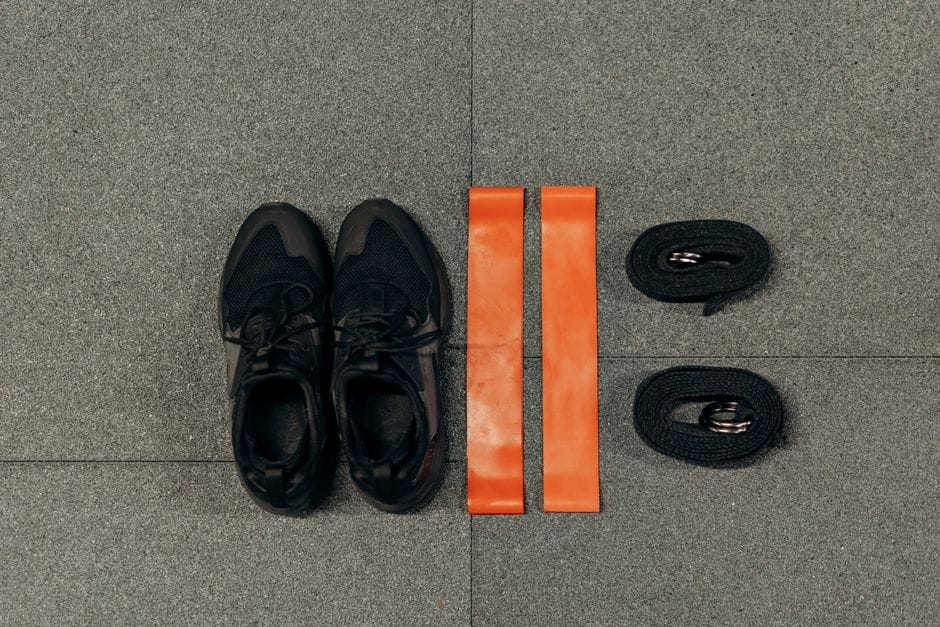
What they do that dumbbells don't:
- Variable resistance: bands get harder as you stretch them, which loads muscles at the peak of contraction — exactly where you're strongest.
- Mobility and warm-up work: clam shells, hip circles, band pull-aparts for shoulder health.
- Assisted pull-ups and dips: loop a heavy band over a bar or sturdy door anchor to reduce your bodyweight and build up strength.
- Travel training: a full set weighs under a pound and fits in a laptop bag.
Look for latex loop bands in a variety that includes at least light (10–20 lb), medium (20–40 lb), and heavy (40–80 lb) resistance. Fabric hip bands are also worth having for glute activation work.
3. A Quality Non-Slip Mat (Don't Cheap Out Here)
A proper exercise mat is one of the most overlooked purchases — until you try to do a plank on hardwood floor and ruin your elbows. A good mat does double duty as a yoga/stretching surface and a floor protection layer for your dumbbells.
What to look for:
- Thickness: 6–8 mm for floor exercises; if you're doing heavy kettlebell or dumbbell work, a 12–15 mm interlocking foam tile set provides better floor protection.
- Non-slip texture on both surfaces (top and bottom).
- Size: at minimum 68" × 24" so your full body fits lying down.
Avoid thin yoga mats (under 4 mm) for strength training — they compress flat under load and provide zero cushioning. A purpose-built exercise mat or interlocking foam tiles is the better call for a home gym.
4. A Pull-Up Bar (The Vertical Dimension)
Most home gym setups are horizontal: you press, curl, squat, and lunge. A pull-up bar adds the vertical plane — pulling your bodyweight up — which is one of the single best upper-body movements you can do.
Types:
- Doorframe bars: the cheapest option ($20–$40), no installation, removable. Good for beginners. Make sure your doorframe is standard width (usually 24–36").
- Wall-mounted bars: more stable, higher weight capacity, requires drilling. Best for intermediate to advanced users who train regularly.
- Power tower: adds dip bars and knee raise handles but takes up significant floor space — only worth it if you have the room.
A doorframe bar is sufficient for most people. Pair it with your heavy resistance band and you have an assisted pull-up station immediately.
What you can do with it: pull-ups, chin-ups, neutral-grip pull-ups, hanging knee raises, leg raises, L-sits, and with a band: assisted pull-ups and bodyweight rows (feet on floor, bar at hip height in a doorway).
5. A Jump Rope (Cardio That Actually Works)
Cardio equipment is where home gym budgets go to die. Treadmills are expensive, loud, and take up a room. Stationary bikes collect dust. A jump rope costs $15–$40, stores in a drawer, and delivers a brutally effective cardio session in 10–15 minutes.
What to look for:
- Weighted handles (1–3 oz) improve feedback and make timing easier for beginners.
- Adjustable cable length: standard rule is to stand on the middle of the rope — handles should reach armpit height.
- Speed rope vs. weighted rope: speed ropes (thin cable) are better for high-rep conditioning; weighted jump ropes (thicker cable) build more shoulder and arm endurance per session.
If you have low ceilings, substitute with a speed ladder on the floor or simply substitute jumping jacks and high knees — the goal is elevated heart rate, not the tool.
What You Don't Need (Save Your Money)
Bench: A floor press with dumbbells hits your chest and triceps almost identically to a flat bench press. Incline is harder to replicate, but most beginners don't need it.
Barbell + squat rack: Excellent tools, but take up serious space and require safety considerations at home. Goblet squats, Bulgarian split squats, and Romanian deadlifts with heavy adjustable dumbbells get you 90% of the benefit.
Cable machine: Resistance bands mimic cable exercises extremely well at a fraction of the cost.
Smart mirror / Peloton: Great technology, but $1,500+ for a screen you can replicate with a free YouTube channel and a $15 jump rope.
How to Arrange Your Space
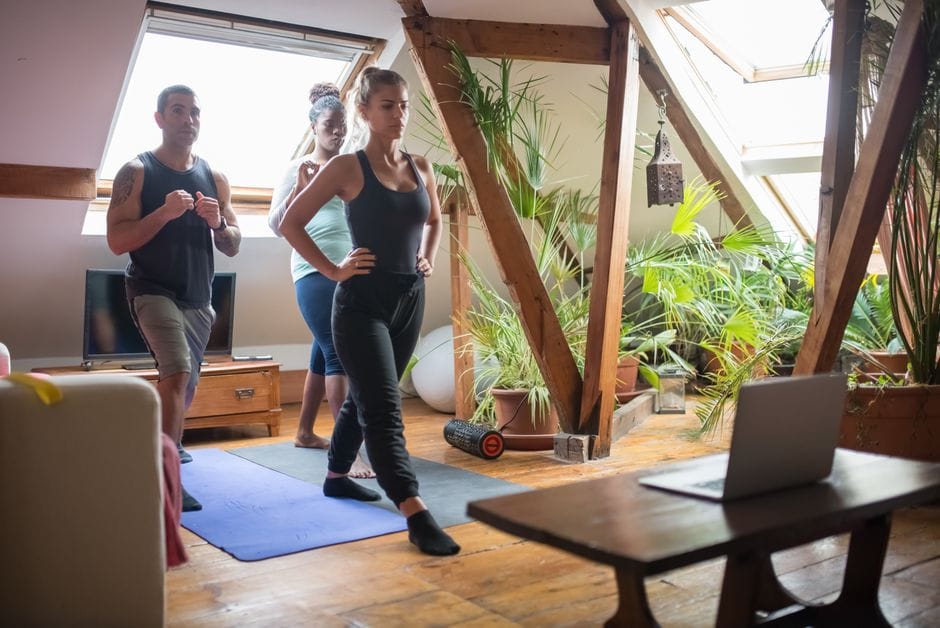
You don't need a dedicated gym room. A 6 × 8-foot clear space — the size of a large area rug — is sufficient for the full five-piece setup. Keep your mat rolled up, your bands hanging on a hook, your dumbbells on a small two-tier rack (optional, keeps them off the floor), and your pull-up bar mounted in the nearest doorway.
Good ventilation and natural light make a real difference in how often you actually use the space. If your setup is in a garage or basement, add a box fan and a bright LED work light.
A Sample Week With These 5 Tools
Day 1 (Upper — Push): dumbbell floor press 3×10, shoulder press 3×12, lateral raise 3×15, tricep kickback 3×15, jump rope 10 min
Day 2 (Lower): goblet squat 3×12, Romanian deadlift 3×10, banded clam shell 3×20, walking lunges 3×10 each, jump rope 8 min
Day 3 (Upper — Pull): pull-ups or assisted pull-ups 3×max, bent-over row 3×10, banded face pull 3×15, bicep curl 3×12
Day 4 (Rest or mobility): mat stretching, yoga video, foam rolling
Day 5 (Full body circuit): 5 exercises back-to-back, 40 sec on / 20 sec off × 4 rounds
The Takeaway
A minimalist home gym built around adjustable dumbbells, resistance bands, a quality mat, a pull-up bar, and a jump rope covers the full spectrum of fitness — strength, cardio, mobility, and core. Total cost: $150–$300 depending on the dumbbell range you choose. Total floor space: roughly the size of a parking spot. The equipment available in that footprint, used consistently, will outperform a neglected $3,000 home gym setup every time.
Buy the essentials, set them up somewhere visible, and start training this week.
Frequently Asked Questions
Do I really need adjustable dumbbells, or can I start with a single fixed pair?
A single fixed pair limits your progress quickly. Bicep curls and shoulder press require very different weights. Adjustable dumbbells let you train every muscle correctly from day one — they're worth the upfront investment.
How much space do I actually need for these five pieces?
About 6 × 8 feet of clear floor is enough for mat exercises and dumbbell work. The pull-up bar mounts in a doorway and takes no floor space. The jump rope needs roughly 4 feet of ceiling clearance.
Can I build real muscle with just dumbbells and bands?
Yes — research consistently shows that resistance bands and dumbbells produce comparable muscle growth to barbell training when taken close to failure with sufficient volume. The key is progressive overload: add weight or reps over time.
What's the best first purchase if my budget is under $50?
A set of resistance bands ($20–$30) plus a quality mat ($20–$30). You can do a full-body workout with bands alone while you save up for adjustable dumbbells.
Read next
Related articles
- Walking for Weight Loss: A Beginner’s Guide
- Intermittent Fasting for Beginners: A Complete Guide (2026)
- How Much Protein Do You Really Need? A Science-Backed Guide
- How to Lose Fat: A Complete Beginner’s Guide (2026)
- How to Build Muscle: A Complete Beginner’s Guide (2026)
- 15 Tiny Daily Habits That Quietly Transform Your Health
Further reading & trusted sources
The detail that makes the difference
The most common minimalist home gym mistake is buying five pieces of equipment and using one — usually the mat. Adjustable dumbbells are the exception because the weight range forces you to engage at the right intensity for every exercise, which is the only thing that actually drives change.
Maya’s editorial obsession is the gap between fitness hype and what the evidence actually shows — she’d rather hand you one boring habit that works than ten exciting ones that don’t. She builds FitNourish’s guides from mainstream, well-established sources (the CDC, the NHS, Mayo Clinic, and peer-reviewed research) and has a human review every one for accuracy before it publishes. She and the team are dedicated fitness enthusiasts and researchers, not doctors, so everything here is general information rather than medical advice. AI tools help with the research and drafting; the fact-checking and judgement are human.