 By Maya Reed, Editor
Reviewed & updated September 2026 · Researched, AI-assisted & human-reviewed
Educational information only — not medical advice. Learn more
The overhead press looks simple — pick the weight up, push it over your head, put it down — which is exactly why so many people get it wrong. Small breakdowns in bar path, bracing, or shoulder position turn a straightforward strength move into a source of nagging shoulder pain, and most of that comes down to a handful of fixable habits.
This article shares general fitness information, not medical advice. If you have a shoulder injury or ongoing pain, check with a doctor or physical therapist before adding overhead pressing to your routine.
 What you’ll find insideCurated by Maya · 7 min read
Why the overhead press is worth doing
The overhead press builds shoulder and upper-back strength that barely gets touched by pushing exercises done lying down, like the bench press. It also trains total-body bracing — your core, glutes, and legs all have to stay tight to keep the weight stacked over your center of gravity — so it doubles as a stability drill disguised as a shoulder exercise. Because there's no bench or machine to lean on, it also exposes weak links (usually the core or upper back) faster than almost any other lift.
Setting up the starting position
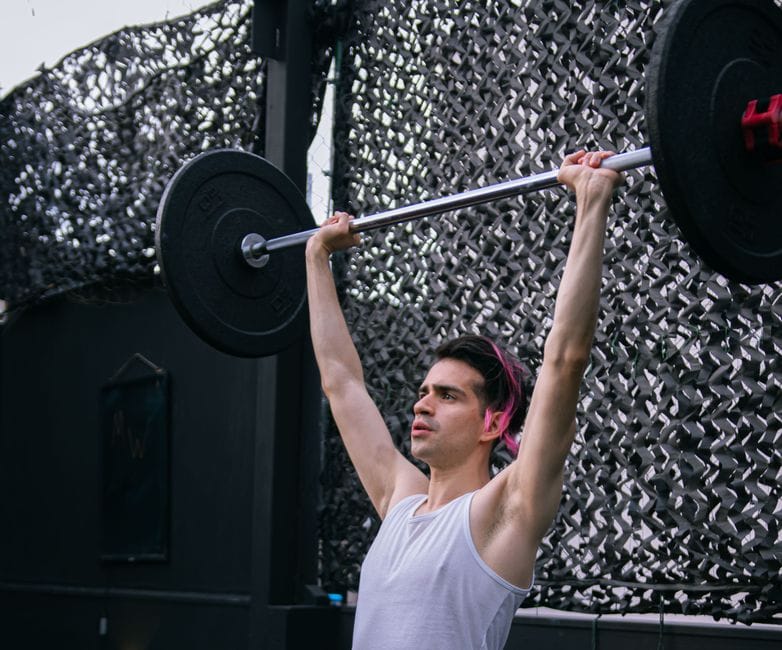
Stand with feet shoulder-width apart, grip the bar just outside shoulder width, and rest it on the front of your shoulders with your elbows slightly in front of the bar rather than flared straight out. Your wrists should stack directly over your elbows — a bar that sits back in your palm forces your wrist into an awkward angle under load. Take a breath, brace your core like you're about to take a light punch to the stomach, and squeeze your glutes to lock your hips in place before you press.
The press itself
- Press straight up, not forward. As the bar clears your face, move your head slightly back and then push it through once the bar passes forehead height, so the bar travels in a straight vertical line rather than looping forward.
- Finish with the bar over your mid-foot. At lockout, your ears should be roughly in line with your upper arms and the bar should sit directly above the middle of your foot — not out in front of your face.
- Keep your ribs down. Don't let your lower back arch to help the bar up; that shifts load off your shoulders and onto your spine. If you feel your ribs flaring up and lower back arching, the weight is too heavy for now.
- Lower with control. Bring the bar back down along the same vertical path, resisting gravity rather than dropping it, and let your elbows come back to the starting position before the next rep.
The most common mistakes
- Flaring the elbows out to the sides at the start. This puts the shoulder in a weaker, more exposed position. Keep elbows slightly forward under the bar instead.
- Turning it into an incline press by leaning back. If your torso is leaning noticeably backward, the weight is either too heavy or your core bracing isn't holding — both are worth fixing before adding load.
- Not moving the head out of the bar's way. Trying to keep your head perfectly still forces the bar to loop around your face, wasting effort and encouraging exactly the arching mentioned above.
- Pressing before bracing. Bracing your core and glutes has to happen before you initiate the press, not halfway through the rep once the bar is already moving.
Dumbbell vs. barbell overhead press
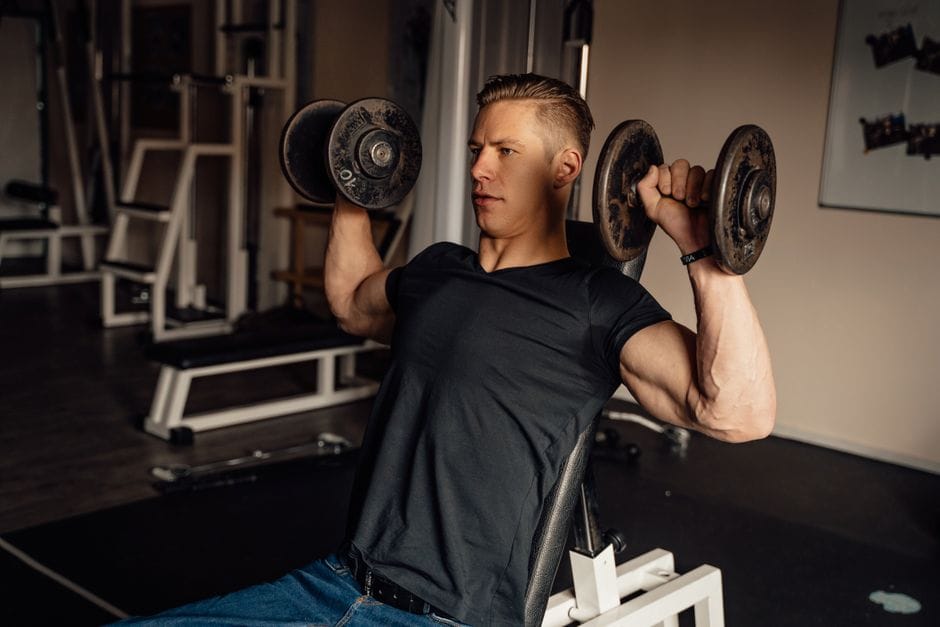
Dumbbells let each arm move independently, which is useful if one side is noticeably weaker or your shoulders don't love a fixed bar path — the joint has more freedom to find a comfortable groove. A barbell lets you load more total weight and makes progression easier to track in small increments. Neither is "better" outright: many people use dumbbells to build stability and work around shoulder quirks, then move to a barbell once the pattern feels solid and they want to push heavier weight.
How to build up to it safely
If a full standing overhead press feels out of reach right now, start with seated dumbbell presses, which remove the leg-and-hip bracing component and let you focus purely on the pressing pattern. From there, progress to standing dumbbell presses once your core can hold a strict, controlled position, and only move to a barbell once dumbbell form is clean at a comparable weight per side. Landmine presses (pressing a barbell anchored at one end, at an angle) are another good bridge — they're gentler on the shoulder joint while still building pressing strength.
How often and how much
Two to three sets of six to ten reps, once or twice a week, is a solid starting point for most beginners — it's enough volume to build strength without so much fatigue that your form breaks down by the last set. Progress slowly: adding 2.5-5 lbs total once you can complete all sets and reps with clean form is safer than chasing bigger jumps that force your technique to slip.
The takeaway
A proper overhead press comes down to a tight brace, a genuinely vertical bar path, and elbows that start slightly forward rather than flared out — get those three things right and the rest of the lift tends to fall into place. Start light, build the pattern with dumbbells if a barbell feels unstable, and let your form — not your ego — decide when to add weight.
Frequently asked questions
Is the overhead press bad for your shoulders?
Not inherently — most shoulder discomfort from overhead pressing traces back to flared elbows, a backward-leaning torso, or pressing with too much weight before the pattern is solid, not the movement itself.
Should I press behind my neck instead of in front?
No — behind-the-neck pressing puts the shoulder in a much more vulnerable position for most people and offers no real advantage over pressing from the front.
What muscles does the overhead press work?
Primarily the shoulders (deltoids) and triceps, with real secondary work for the upper chest, upper back, and core, since your midsection has to stay braced to keep the bar stacked overhead.
Can I do the overhead press if I don't have full shoulder mobility?
Work within a comfortable range and consider dumbbells over a barbell, since they let each arm find its own path — but if pressing overhead consistently causes pain rather than normal muscle fatigue, that's worth having checked before continuing.
Read next

Further reading & trusted sources
The detail that makes the difference
Most new lifters lose the vertical bar path by keeping their head perfectly still, which forces the bar to arc around the face and pulls the lower back into an arch that has nothing to do with weakness — the fix is moving the head back and then through, not adding core work. A dumbbell overhead press exposes a side-to-side strength imbalance almost immediately, since each arm has to stabilize independently, which is why it’s often a better diagnostic tool than a barbell before committing to heavier barbell work.
Maya’s editorial obsession is the gap between fitness hype and what the evidence actually shows — she’d rather hand you one boring habit that works than ten exciting ones that don’t. She builds FitNourish’s guides from mainstream, well-established sources (the CDC, the NHS, Mayo Clinic, and peer-reviewed research) and has a human review every one for accuracy before it publishes. She and the team are dedicated fitness enthusiasts and researchers, not doctors, so everything here is general information rather than medical advice. AI tools help with the research and drafting; the fact-checking and judgement are human.