 By Maya Reed, Editor
Reviewed & updated September 2026 · Researched, AI-assisted & human-reviewed
Educational information only — not medical advice. Learn more
The goblet squat is one of the best squat variations for beginners because holding the weight in front of you naturally pulls your torso upright and teaches good depth without a barbell on your back. It's also a great accessory lift for lifters who already squat heavy, since it builds the same pattern with far less spinal load.
This article is for general fitness education, not personalized training or medical advice. Check with a doctor or trainer before starting a new exercise routine, especially if you have joint or back issues.
 On this pageCurated by Maya · 7 min read
What is a goblet squat?
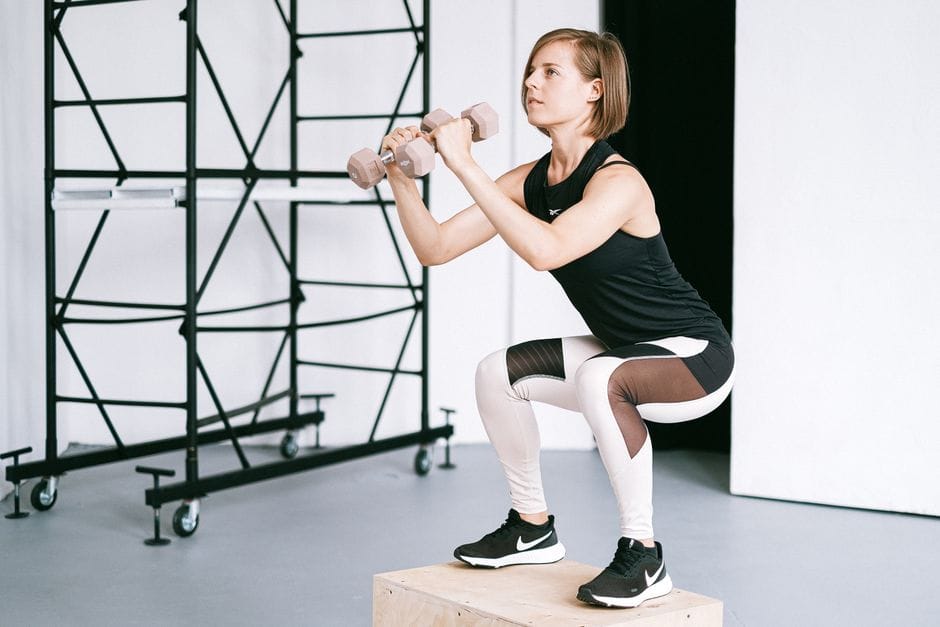
A goblet squat is a squat performed while holding a single dumbbell or kettlebell vertically against your chest, cupped in both hands like a goblet. The weight acts as a counterbalance — it pulls your center of gravity slightly forward, which makes it much easier to keep your chest tall and sit into a deep, controlled squat than a bodyweight squat or barbell back squat often is for beginners.
Strength coach Dan John, who popularized the goblet squat, calls it the single best exercise for teaching squat mechanics because the loading position self-corrects a lot of common form breakdowns automatically.
Muscles worked
- Quadriceps — the primary mover, especially through the deep bottom range
- Glutes — drive the hips back up out of the bottom position
- Adductors (inner thighs) — stabilize the wide stance and control knee tracking
- Core and upper back — work isometrically to keep the torso upright against the front-loaded weight
- Grip and forearms — from holding the dumbbell or kettlebell tight to your chest
Step-by-step: how to do a goblet squat
- Set up your stance. Stand with feet slightly wider than shoulder-width, toes turned out 15-30 degrees.
- Hold the weight correctly. Cup one end of a dumbbell vertically against your upper chest and chin, elbows pointing down, or hold a kettlebell by the horns at chest height.
- Brace your core. Take a breath into your belly and tighten your midsection before you start moving.
- Sit down and back. Bend your knees and hips together, pushing your hips back like you're sitting into a low chair. Keep your elbows tucked between your knees as you descend.
- Go as deep as you can control. Aim to get your elbows to lightly touch the inside of your knees, or your hip crease below knee level, while keeping your heels flat and your lower back neutral.
- Drive back up. Push through the middle of your foot, squeeze your glutes, and stand back to the starting position without your knees caving inward.
- Repeat for reps, keeping the weight tight to your chest the entire time — don't let it drift forward.
Common mistakes
- Letting the weight drift away from the chest. The further the dumbbell moves from your body, the more it pulls you forward and strains your lower back. Keep it glued to your sternum.
- Rounding the upper back. A rounded spine under load is uncomfortable and inefficient — think "proud chest" the whole way down.
- Knees caving inward. Actively push your knees out in the direction of your toes as you descend and stand.
- Rising onto the toes. Weight should stay through the whole foot, with slightly more pressure on the heels — if your heels lift, you may need to widen your stance or work on ankle mobility.
- Stopping the depth too early. Many people quit at a quarter squat out of habit. The goblet squat's whole advantage is that it lets you safely explore a deeper range — use it.
How to program goblet squats
Goblet squats work well as:
- A teaching tool for 2-4 weeks before progressing to barbell squats
- A main lower-body lift for beginners: 3-4 sets of 8-12 reps, 2x per week
- An accessory or finisher for more advanced lifters: 2-3 sets of 12-20 reps after heavier compound work
- A warm-up movement to groove the squat pattern and open the hips before heavier training
Rest 60-90 seconds between sets for higher-rep, accessory-style work, or up to 2 minutes if it's your main lift for the day.
How much weight should you use?
Start lighter than you think — a 15-25 lb dumbbell is plenty for most beginners to learn the pattern. The goblet squat is limited by how much weight you can comfortably hold at your chest, which is exactly why it's self-limiting and beginner-friendly: you're unlikely to load it heavy enough to hurt yourself the way a poorly-loaded barbell squat could. Once bodyweight-holding a weight equal to roughly a third of your bodyweight for 10+ clean reps feels easy, it's a reasonable time to explore front or back squats if that's your goal.
Goblet squat variations
- Goblet squat with a pause — hold the bottom position for 2-3 seconds to build strength through the deepest range and improve control
- Goblet squat pulse — small pulsing reps at the bottom before standing, great as a finisher
- Kettlebell goblet squat — the horn grip shifts the weight slightly differently and many people find it more comfortable on the wrists
- Goblet squat to box — squatting to a bench or box helps beginners find consistent depth and builds confidence
The takeaway
The goblet squat earns its reputation as the best squat for beginners because the front-loaded position naturally corrects your posture and makes deep, controlled reps easier to learn than almost any other squat variation. Start with a manageable weight, focus on keeping the dumbbell tight to your chest and your chest tall, and let depth improve gradually as your mobility and confidence build. It's a lift worth keeping in your program long after you've "graduated" to barbells — plenty of advanced lifters still use it as a staple leg day movement.
Frequently asked questions
Is the goblet squat better than a regular squat?
Neither is universally "better" — they serve different purposes. The goblet squat is easier to learn with good form and is gentler on the lower back, making it ideal for beginners or as an accessory lift. Barbell squats allow much heavier loading for advanced strength goals once the pattern is mastered.
How deep should a goblet squat go?
Aim for your hip crease to drop at or below your knee level if your mobility allows it comfortably, with your heels staying flat on the floor. Depth should never come at the cost of your lower back rounding — go only as deep as you can control with good form.
Can goblet squats build muscle?
Yes. Goblet squats effectively target the quads, glutes, and adductors, and can build meaningful muscle and strength, especially for beginners and intermediate lifters. As you get stronger, grip and the ability to hold heavier weight at your chest can become the limiting factor rather than your legs.
What can I use if I don't have a dumbbell or kettlebell?
A weight plate held vertically against your chest works well, and so does a heavy household object like a full water jug or a loaded backpack held close to your torso — the same form cues apply regardless of what you're holding.
Read next
Further reading & trusted sources
Where beginners usually go wrong
The dumbbell drifting an inch or two away from the chest is usually the actual cause when someone reports lower back fatigue from goblet squats, since the pull-forward moment arm grows fast even from a small gap — most people don’t notice the drift happening in real time because it feels the same in the hands. Elbows brushing the inside of the knees near the bottom is a more reliable depth check than watching hip crease height in a mirror, since the mirror angle is easy to misjudge but the elbow contact is unmistakable.
Maya’s editorial obsession is the gap between fitness hype and what the evidence actually shows — she’d rather hand you one boring habit that works than ten exciting ones that don’t. She builds FitNourish’s guides from mainstream, well-established sources (the CDC, the NHS, Mayo Clinic, and peer-reviewed research) and has a human review every one for accuracy before it publishes. She and the team are dedicated fitness enthusiasts and researchers, not doctors, so everything here is general information rather than medical advice. AI tools help with the research and drafting; the fact-checking and judgement are human.