 By Maya Reed, Editor
Reviewed & updated September 2026 · Researched, AI-assisted & human-reviewed
Educational information only — not medical advice. Learn more
Pilates looks gentle — small, controlled movements, no sweat-soaked intensity — which is exactly why people underestimate it until their core is shaking five minutes in. It builds the deep stabilising muscles that posture, balance, and a pain-free back depend on, and you can start on a mat at home with no reformer in sight.
This article is for general fitness education only, not medical advice. If you have an injury, chronic pain, or health condition, consult your doctor or a qualified physical therapist before starting a new exercise program.
 Quick navigationCurated by Maya · 9 min read
- What Is Pilates (and Why It’s Not Just Stretching)
- The Core Principles You Need to Know First
- What Equipment Do You Actually Need?
- The Foundational Exercises (Start Here)
- A Sample 30-Minute Beginner Routine
- How Quickly Will You See Results?
- Common Beginner Mistakes to Avoid
- Free Resources to Get Started
- The Takeaway
- Related articles
- Further reading & trusted sources
What Is Pilates (and Why It's Not Just Stretching)
Pilates was developed in the early 20th century by Joseph Pilates, originally as a rehabilitation method. It focuses on controlled movement, core engagement, breath, and alignment — but don't mistake it for gentle stretching. Properly performed Pilates challenges your deep stabilizer muscles in ways that squats and crunches simply don't reach.
There are two main styles:
- Mat Pilates: Done on a yoga mat using your bodyweight. Great for beginners and home workouts.
- Reformer Pilates: Uses a spring-resistance machine found in studios. More advanced and more expensive, but highly effective.
For beginners starting at home, mat Pilates is the ideal entry point. You'll need only a mat, some floor space, and about 20–40 minutes.
The Core Principles You Need to Know First
Before jumping into exercises, understanding these six principles will make every move more effective:
Centering — All movement originates from your "powerhouse" (deep core, lower back, hips, and glutes). Every exercise should feel connected to this center.
Concentration — Pilates is a mindful practice. Focus on the quality of each movement, not the quantity. Ten precise repetitions beat fifty sloppy ones.
Control — You should never flop into or out of a position. Every transition is part of the exercise.
Precision — Small alignment details matter. Where your shoulders are, whether your ribcage is lifted, how your toes are pointed — these aren't cosmetic.
Breath — Traditional Pilates uses a specific breath pattern: inhale through the nose to prepare, exhale through the mouth on the exertion. This keeps your core engaged without holding your breath.
Flow — Movements should be smooth and fluid, not jerky or rushed.
What Equipment Do You Actually Need?
Essentials (free or cheap):
- A quality yoga mat with some cushioning (8mm or thicker is comfortable for spine-based work)
- Comfortable, form-fitting clothing (loose clothes make it hard to see your alignment)
- Bare feet or grip socks
Optional upgrades:
- A Pilates ring (also called a magic circle) — adds light resistance, great for inner thigh and arm work
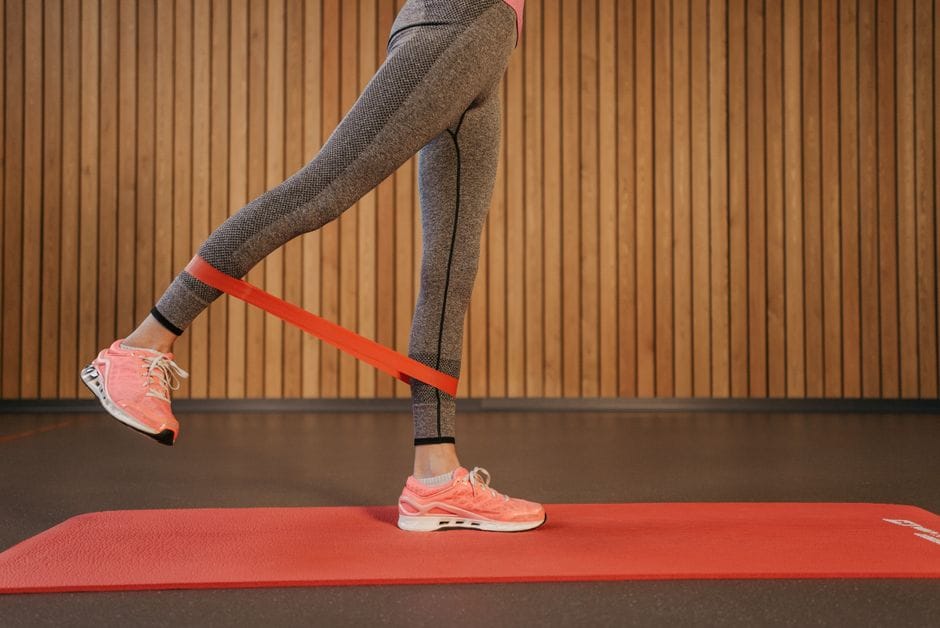
- Resistance bands — useful for footwork and hip strengthening
- A small Pilates ball — helps with inner thigh squeezes and back support
You do not need a reformer machine to see real results. Most of the foundational work is on the mat.
The Foundational Exercises (Start Here)
These are the classic beginner moves. Master these before advancing:
The Hundred
Lie on your back with legs in tabletop position (knees bent at 90°). Lift your head, neck, and shoulders off the mat. Extend your arms long by your sides and pump them up and down in small, controlled pulses — 5 pumps on the inhale, 5 on the exhale. Work toward 100 pumps total. This warms up your core and trains breath endurance.
Pelvic Curl (Bridge)
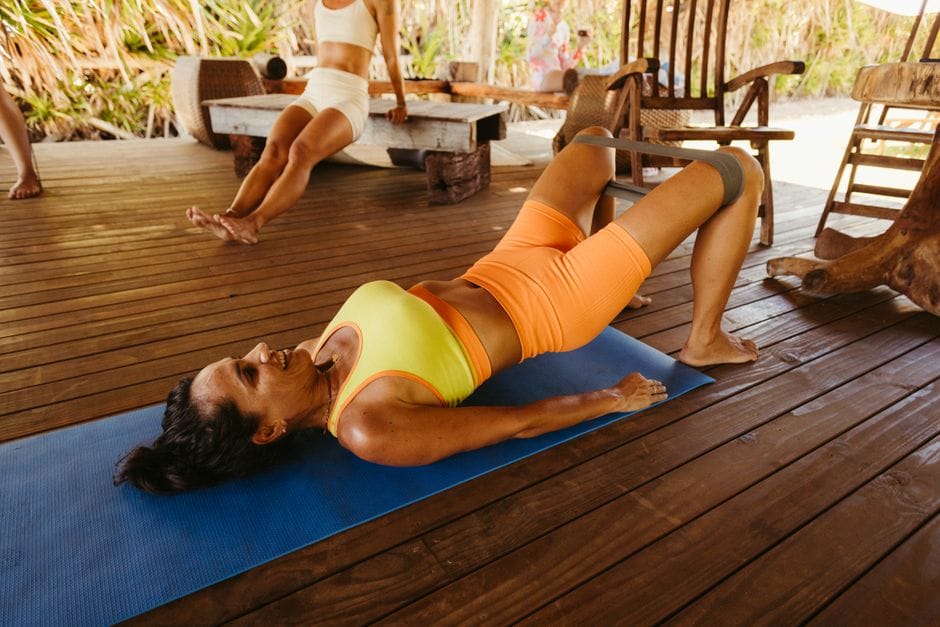
Lie on your back, feet flat on the floor hip-width apart. Inhale to prepare. Exhale and peel your spine off the mat one vertebra at a time, rolling up to a bridge. Inhale at the top, then exhale as you roll back down slowly. This mobilizes the spine and strengthens the glutes and hamstrings.
Single Leg Stretch
From your back, hug one knee to your chest while extending the other leg out at a 45° angle. Lift your head, neck, and shoulders. Switch legs in a controlled alternating motion. Keep your lower back pressed into the mat — if it arches, lift your extended leg higher.
The Roll-Up
Lie flat. Inhale as you reach arms overhead. Exhale and slowly roll up to sitting, reaching toward your toes. Inhale at the top, then exhale as you roll back down with control. This replaces crunches and trains your spine's articulation. If your feet lift or you jerk up, place your hands behind your thighs to assist.
Spine Stretch Forward
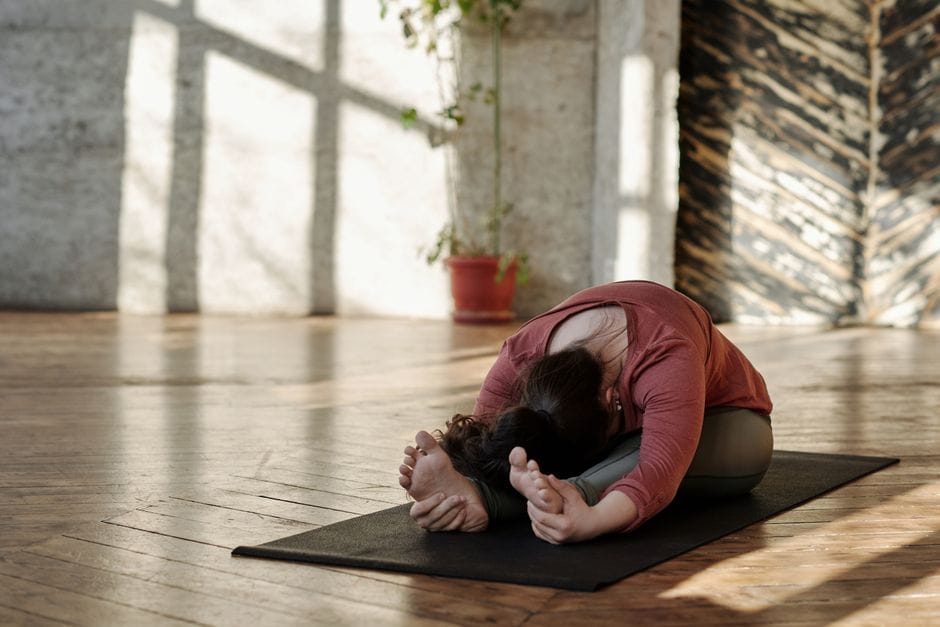
Sit tall with legs extended in front of you (slightly bent if your hamstrings are tight). Inhale to grow tall. Exhale and round forward as if curving around a big ball — not collapsing forward, but creating space between each vertebra. Inhale to hold, exhale to return upright.
Swan Prep
Lie on your stomach with hands under your shoulders. Inhale to prepare. Exhale and press through your hands to lift your chest, keeping your elbows slightly bent and your lower back long (not crunching into it). Inhale at the top, exhale to lower. This counters all the spinal flexion and strengthens your back extensors.
Side-Lying Leg Lifts
Lie on your side in a straight line. Exhale and lift your top leg to hip height. Inhale as you lower. Keep your waist lifted off the mat and your core engaged. Progress to front-and-back swings and circles. This targets the hip abductors and stabilizes the pelvis.
A Sample 30-Minute Beginner Routine
Do this 3 times per week, with at least one rest day between sessions:
| Exercise | Reps / Duration |
|---|---|
| Breathing + pelvic floor activation | 1 minute |
| Pelvic Curl (Bridge) | 8 reps |
| Single Leg Stretch | 10 reps each side |
| The Hundred | 60–100 pumps |
| Roll-Up (or assisted) | 6–8 reps |
| Spine Stretch Forward | 5 reps |
| Side-Lying Leg Lifts | 10 reps each side |
| Swan Prep | 6 reps |
| Child's Pose (rest) | 30 seconds |
| Standing Footwork / Balance | 2 minutes |
Rest as needed between exercises. The goal is control, not speed.
How Quickly Will You See Results?
Joseph Pilates famously said: "In 10 sessions you'll feel the difference, in 20 you'll see the difference, and in 30 you'll have a new body." That's roughly true for many beginners. Most people notice improved posture and core awareness within 2–3 weeks of consistent practice (3x/week). Visible strength and body composition changes typically come at 6–8 weeks.
Key signs of progress in Pilates aren't always visible at first — they're felt: your lower back aches less, you sit taller without thinking about it, movements feel more coordinated.
Common Beginner Mistakes to Avoid
Straining your neck — In exercises like the Hundred or Single Leg Stretch, beginners often pull their head up with their hands and tense their neck. Instead, keep your chin slightly tucked, your gaze toward your knees, and think about peeling your shoulder blades off the mat rather than pulling your head.
Holding your breath — The Pilates breath is counterintuitive at first. Exhale on the exertion. If you lose track of the breath cue, just breathe naturally and add the breath pattern back in once the movement feels stable.
Rushing the repetitions — Pilates is slow on purpose. If your reps are fast, you're likely compensating with momentum instead of muscle control. Slow down and feel the muscles working.
Pushing through pain — Discomfort from muscle fatigue is normal. Sharp pain, especially in the lower back or joints, is not. Stop and check your alignment.
Free Resources to Get Started
You don't need to spend money to access excellent beginner Pilates content. YouTube has excellent free programs from qualified instructors — look for channels that emphasize alignment cues and modifications. Many Pilates studios also offer free introductory classes or low-cost trial months.
A good beginner program will:
- Focus on foundational exercises for the first 4–6 weeks
- Include modifications for common limitations (tight hamstrings, wrist discomfort, lower back sensitivity)
- Progress gradually — adding new exercises only after you've mastered the basics
The Takeaway
Pilates is one of the most transferable forms of exercise — the core strength, body awareness, and postural habits it builds carry over into everything else you do, from lifting groceries to sitting at a desk to running a 5K. Starting as a beginner at home is completely realistic. Focus on the fundamentals, practice consistently three times a week, and prioritize precision over intensity. The results will come.
Frequently Asked Questions
Is Pilates good for weight loss?
Pilates builds lean muscle and improves metabolic function, but it burns fewer calories per session than cardio or high-intensity training. It's most effective for weight management when combined with a varied exercise routine and a balanced diet — not as a standalone fat-loss tool.
Can I do Pilates every day as a beginner?
Daily Pilates is possible, but beginners should aim for 3 sessions per week and allow recovery days. Your muscles — especially the deep stabilizers Pilates targets — need time to adapt. As you advance, light daily practice (20 minutes) becomes more appropriate.
Do I need to be flexible to start Pilates?
No. Pilates builds flexibility over time; you don't need to arrive with it. Modifications exist for every exercise. Tight hamstrings, limited mobility, or stiff hips are common starting points — not barriers.
How is Pilates different from yoga?
Both emphasize mindful movement and breathing, but they differ in focus. Yoga is a holistic practice rooted in tradition, emphasizing flexibility, balance, and often a spiritual dimension. Pilates is primarily a strength and rehabilitation method focused on core control, spinal alignment, and muscular balance. Many people practice both and find them highly complementary.
Read next
Related articles
- Home Gym Setup Ideas for Beginners
- Small Space Home Gym Ideas: Set One Up in Any Apartment
- The Best Glute Workout at Home (No Equipment Needed)
- HIIT Workouts for Beginners: A Complete Guide
- How to Warm Up Before a Workout
- How to Improve Your Flexibility: A Beginner’s Guide
Further reading & trusted sources
A common mistake to skip
Pilates beginners most often strain their neck in core exercises because they’re pulling the head up with muscle tension rather than peeling the shoulder blades off the mat. The fix is to think ‘chest up’ instead of ‘chin up’ — it changes the whole feel immediately.
Maya’s editorial obsession is the gap between fitness hype and what the evidence actually shows — she’d rather hand you one boring habit that works than ten exciting ones that don’t. She builds FitNourish’s guides from mainstream, well-established sources (the CDC, the NHS, Mayo Clinic, and peer-reviewed research) and has a human review every one for accuracy before it publishes. She and the team are dedicated fitness enthusiasts and researchers, not doctors, so everything here is general information rather than medical advice. AI tools help with the research and drafting; the fact-checking and judgement are human.