 By Maya Reed, Editor
Reviewed & updated September 2026 · Researched, AI-assisted & human-reviewed
Educational information only — not medical advice. Learn more
Mountain climbers look simple, but most people rush the tempo and lose the plank the exercise depends on. Done right, they build core strength, hip mobility, and cardio conditioning all in one move — no equipment required.
This article is for general fitness education, not medical advice. Talk to a healthcare provider before starting a new exercise routine, especially if you have a wrist, shoulder, or lower back condition.
 What you’ll find insideCurated by Maya · 7 min read
What muscles do mountain climbers work?
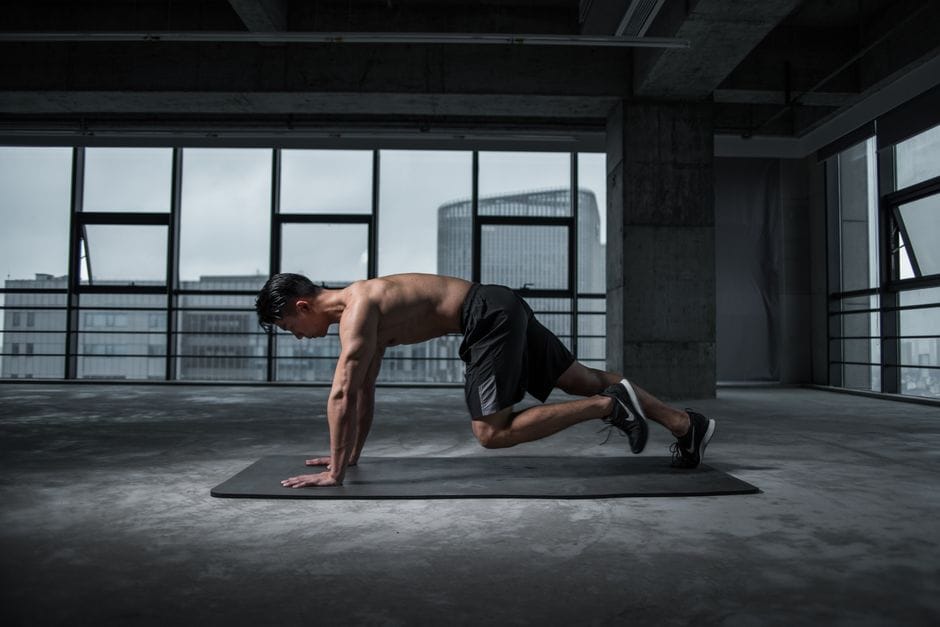
Mountain climbers are a compound, full-body move. The primary work happens in your core — rectus abdominis, obliques, and deep stabilizers — because your torso has to stay rigid while your legs drive back and forth. Your hip flexors and quads power the knee drive, your shoulders and chest hold the plank position, and your heart rate climbs fast enough that the move doubles as cardio. Few bodyweight exercises hit this many systems at once, which is why mountain climbers show up in everything from HIIT circuits to warm-ups.
Step-by-step: how to do a mountain climber
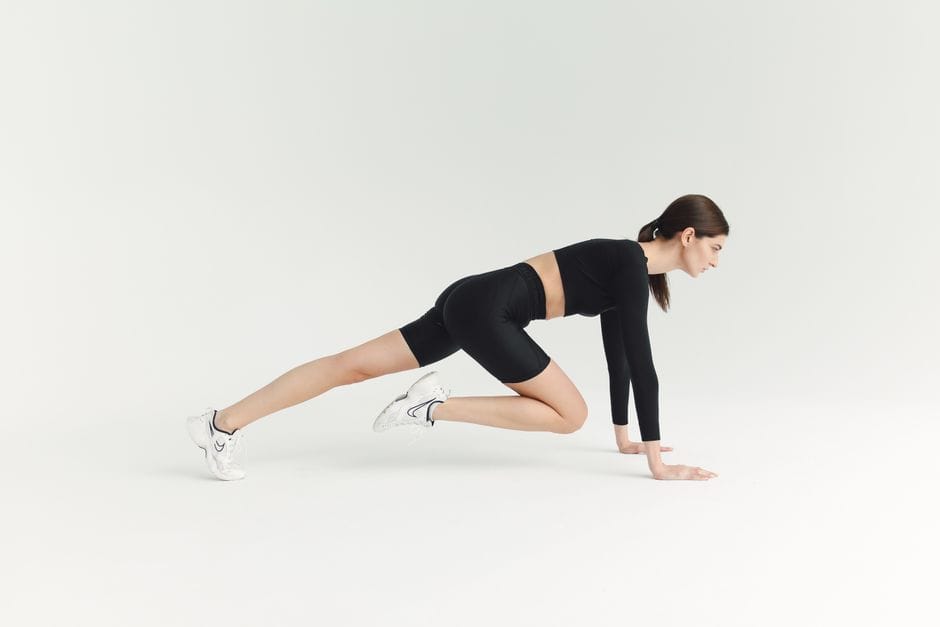
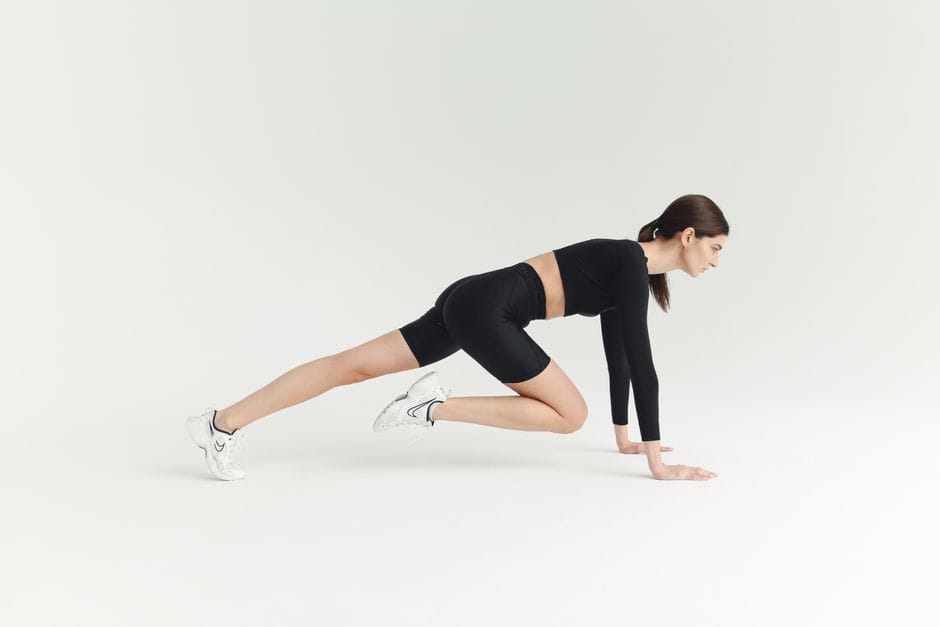
- Start in a high plank. Hands directly under your shoulders, arms straight, body in one line from head to heels. Brace your core like you're about to take a light punch to the stomach.
- Drive one knee toward your chest. Keeping your hips low and your back flat, pull your right knee forward under your torso, landing lightly on the ball of your foot.
- Switch legs in a controlled motion. Push the right foot back to plank as you drive the left knee forward. Think of it as running in place while horizontal, not jumping.
- Keep your hips level. The most common failure point is hips popping up (turns it into a weak hip-flexor stretch) or sagging down (loads the lower back). A flat line from shoulders to ankles is the target the entire time.
- Control your breathing. Exhale as each knee drives forward, inhale as it returns. At faster tempos this becomes more rhythmic than deliberate, but don't hold your breath.
- Build up reps or time. Beginners: 3 sets of 20-30 seconds. Intermediate: 3-4 sets of 30-45 seconds. Advanced: work them into a HIIT circuit at 40 seconds on, 20 seconds off.
Common mountain climber mistakes
Bouncing hips up and down. This is the single biggest form breaker. If your hips are rising and falling with each knee drive, you're using momentum instead of core control — slow down until the plank stays level.
Letting the back round. A rounded upper back usually means your shoulders have drifted past your wrists. Reset your hand position directly under your shoulders and re-brace before continuing.
Hands too far forward or too narrow. Hands should be shoulder-width apart and stacked under the shoulders, not out in front like a downward dog. A forward hand position shifts too much load onto the shoulders and wrists.
Going for speed before control. Fast mountain climbers look impressive, but if your form breaks down at speed, you're training the wrong pattern. Master a slow, controlled 10 reps per side before chasing tempo.
Not fully extending the back leg. Letting the trailing leg stay bent shortens the range of motion and takes work away from the hip flexors and core. Fully extend the back leg with each rep, even at faster speeds.
How to modify mountain climbers
If a full plank position is too intense on your wrists or lower back, you have several regression options that still build the same pattern:
- Elevated mountain climbers: Place your hands on a bench, step, or sturdy countertop instead of the floor. This reduces the load on your upper body and core while you build strength.
- Slow-tempo climbers: Instead of speed, slow each rep down to 2-3 seconds per side. This is actually harder on the core than a fast version and is a great way to learn the pattern.
- Cross-body mountain climbers: Drive your knee toward the opposite elbow instead of straight forward. This adds an oblique-focused rotational element and works well once the standard version feels easy.
- Sliding mountain climbers: Using furniture sliders or a towel on a hardwood floor under your feet adds resistance and forces slower, more controlled movement — a good progression once bodyweight reps feel easy.
How to program mountain climbers into your workouts
Mountain climbers work well in three main roles. As a warm-up, 2 sets of 20 seconds raise your heart rate and prime your hips and core before a strength session. As a core finisher, pair them with planks and dead bugs at the end of a workout for 3 rounds of 30-40 seconds. As a HIIT/cardio element, they slot into circuits alongside jumping jacks, squats, and burpees for 30-45 second work intervals. Because they're low-impact on the joints (no jumping), they're also a reasonable substitute for people easing back into cardio after time off.
The takeaway
Mountain climbers are one of the most efficient bodyweight moves you can do — they build core stability, hip mobility, and cardio capacity without any equipment or much space. The version that actually delivers those benefits is the slow, controlled one with a rock-steady plank, not the fastest version you can manage. Master the tempo before you chase speed, and this move earns a permanent spot in your warm-ups, finishers, and HIIT circuits.
Frequently asked questions
Are mountain climbers good for abs?
Yes — they engage the entire core, including the obliques, far more than a static plank because your torso has to resist rotation while your legs move. They're not a spot-reduction tool for belly fat, but they do build genuine core strength and endurance.
How many mountain climbers should I do a day?
For general conditioning, 3 sets of 30 seconds (or 20-30 reps per side) most days is a reasonable target. As with any exercise, more isn't automatically better — quality of form matters more than volume.
Do mountain climbers count as cardio?
At a fast, sustained pace, yes — they elevate your heart rate similarly to other bodyweight cardio moves like jumping jacks. At a slow, controlled tempo they lean more toward core and stability training with a lighter cardio effect.
Why do my wrists hurt during mountain climbers?
Wrist discomfort usually comes from hands positioned too far forward of the shoulders, or simply too much time under load on an unconditioned wrist. Try the elevated version on a bench or countertop, and make sure your hands are stacked directly under your shoulders.
Read next

Further reading & trusted sources
Where beginners usually go wrong
Hips creeping upward is the hardest form break to catch on yourself because it happens gradually as the legs tire, not all at once — a side-angle video usually reveals it within the first 15 seconds even when the exercise still feels controlled from the inside. The trailing leg not fully extending is the other quiet failure point, since a bent back leg shortens the range of motion enough to noticeably reduce the hip-flexor and core demand even though the rep count stays the same.
Maya’s editorial obsession is the gap between fitness hype and what the evidence actually shows — she’d rather hand you one boring habit that works than ten exciting ones that don’t. She builds FitNourish’s guides from mainstream, well-established sources (the CDC, the NHS, Mayo Clinic, and peer-reviewed research) and has a human review every one for accuracy before it publishes. She and the team are dedicated fitness enthusiasts and researchers, not doctors, so everything here is general information rather than medical advice. AI tools help with the research and drafting; the fact-checking and judgement are human.