 By Maya Reed, Editor
Reviewed & updated September 2026 · Researched, AI-assisted & human-reviewed
Educational information only — not medical advice. Learn more
A kettlebell is one of the few pieces of equipment that can train your whole body — legs, back, shoulders, core, and grip — with a single tool and a small footprint. It looks simple, but the swinging, hinging motion is genuinely different from dumbbell training, and it rewards good form far more than it punishes bad form with soreness alone.
This article shares general fitness information and isn't personalized medical or training advice — check with a doctor before starting a new exercise routine, especially if you have back or joint issues.
 What you’ll find insideCurated by Maya · 7 min read
Why kettlebells are worth learning
Most beginner strength tools train muscles in isolation — a bicep curl, a leg extension. Kettlebell movements are almost all compound and often ballistic, meaning they train multiple muscle groups together through a fast, explosive motion. The kettlebell swing alone works your glutes, hamstrings, lower back, shoulders, and core in one repeated movement, which is why a 20-minute kettlebell session can feel like both a strength workout and a cardio session.
The trade-off is that kettlebell technique matters more than technique with, say, a dumbbell row. The swing is a hip-hinge movement, not a squat and not an arm lift, and getting that distinction wrong is the single most common beginner mistake.
Choosing your first kettlebell
Most beginners start too light or too heavy. A reasonable starting point:
- Women: 8-12 kg (18-26 lb) for swings and general work
- Men: 12-16 kg (26-35 lb) for swings and general work
- Go lighter (4-8 kg) if you're new to any resistance training
You genuinely only need one kettlebell to start. A second, lighter one is useful later for overhead and single-arm work, but it's not required in week one.
The kettlebell swing (the foundation move)
Everything else builds on this pattern, so it's worth taking slowly.
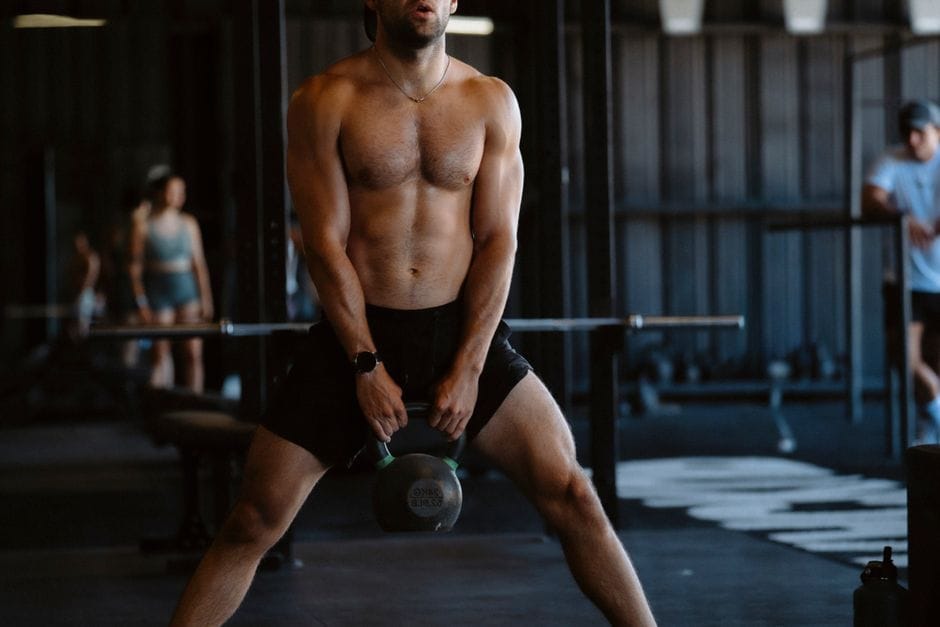
- Stand with feet shoulder-width apart, kettlebell on the floor slightly in front of you.
- Hinge at the hips (not the knees) to grip the handle with both hands, keeping your back flat.
- Hike the kettlebell back between your legs like a football snap, then drive your hips forward explosively — the power comes from your hips and glutes, not your arms.
- Let the kettlebell float up to roughly chest height as your hips finish extending, then let it swing back down and repeat.
- Your arms are just along for the ride — they don't lift the weight, your hips do.
The most common mistake: squatting the swing instead of hinging it. If your knees are bending a lot and your torso stays upright, you're doing a squat with a kettlebell, not a swing. The hips should move back and forward more than the knees bend.
Goblet squat
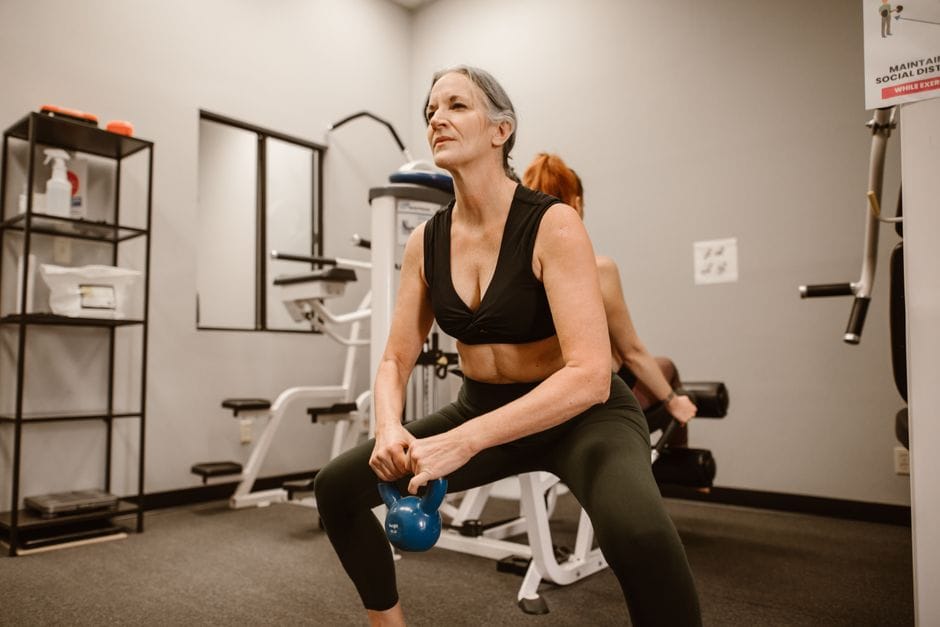
Hold the kettlebell by the "horns" (the sides of the handle) against your chest. Feet just outside shoulder width, toes turned out slightly. Sit down and back like you're reaching for a low chair, keeping your chest up and the kettlebell close to your body. This is one of the safest ways to learn a proper squat pattern because holding weight in front naturally keeps your torso upright.
Kettlebell deadlift
A gentler entry point than the swing if you want to nail hip-hinge mechanics first. Stand over the kettlebell, hinge down keeping your shins mostly vertical, grip the handle, then stand up by driving your hips forward — not by rounding your back and yanking. Push the floor away with your feet rather than pulling with your arms.
Kettlebell row
Hinge forward with a flat back (similar position to the deadlift), let one arm hang straight down holding the kettlebell, then pull it up toward your ribs by driving your elbow back, squeezing your shoulder blade. Lower with control. This builds the pulling strength that a lot of home routines miss.
Halo
Hold the kettlebell by the horns at chest height and circle it slowly around your head, staying close to your skull, switching direction each rep. It's a small movement but it wakes up shoulder mobility and core stability — a good way to warm up before the bigger lifts.
A simple beginner full-body routine
Do this 2-3 times per week, resting a day between sessions while you're new to it:
| Exercise | Sets | Reps |
|---|---|---|
| Halo (warm-up) | 1 | 5 per direction |
| Goblet squat | 3 | 10-12 |
| Kettlebell deadlift | 3 | 10 |
| Kettlebell row (each arm) | 3 | 10 |
| Kettlebell swing | 3 | 15-20 |
Rest 60-90 seconds between sets. Once swings feel controlled and your hips are clearly doing the work, this simple circuit is enough to build real strength and conditioning for months before you need to add complexity.
Common mistakes beyond the squat-swing mix-up
- Rounding the back on the deadlift or swing setup — a flat back protects your spine; if you can't keep it flat, the kettlebell is too heavy or you need to sit your hips back further.
- Using only arm strength on the swing — you should feel your glutes working the next day, not your shoulders.
- Going too heavy too soon — kettlebell moves are technical; more weight just amplifies a flawed pattern.
- Skipping the hinge pattern practice — spend a session or two just practicing hip hinges with light or no weight before loading up.
The takeaway
Kettlebells reward patience with technique far more than most gym equipment — a few sessions spent nailing the hip hinge on the swing and deadlift will do more for you long-term than rushing to add weight. Start with one kettlebell, master the swing, goblet squat, deadlift, and row, and you already have a complete beginner program that fits in a closet.
Frequently asked questions
How often should beginners do kettlebell workouts?
Two to three times a week is plenty when you're starting out, with a rest day between sessions so your body can adapt to the new movement patterns, especially the hip hinge.
Is a kettlebell swing bad for your back?
Done with a proper hip hinge and flat back, swings are generally safe and even strengthen the lower back and glutes. The risk comes from rounding the spine or turning it into a squat — if either happens, lighten the weight and slow down.
Can you get a full workout with just one kettlebell?
Yes. A single kettlebell covers squats, hinges, rows, presses, and carries — enough variety for a genuinely complete beginner program for several months.
How heavy should a beginner kettlebell be?
Most new lifters do well starting around 8-12 kg (women) or 12-16 kg (men) for swings, going lighter if new to resistance training in general. It's better to start light and nail the form than to start heavy and reinforce a bad pattern.
Read next
Further reading & trusted sources
Where beginners usually go wrong
The single most common beginner error isn’t picking the wrong weight, it’s turning the swing into a front squat with a kettlebell in hand — the tell is knees bending a lot while the torso stays upright instead of the hips driving the movement. Filming one set from the side catches this instantly, even when the rep feels correct from the inside.
Maya’s editorial obsession is the gap between fitness hype and what the evidence actually shows — she’d rather hand you one boring habit that works than ten exciting ones that don’t. She builds FitNourish’s guides from mainstream, well-established sources (the CDC, the NHS, Mayo Clinic, and peer-reviewed research) and has a human review every one for accuracy before it publishes. She and the team are dedicated fitness enthusiasts and researchers, not doctors, so everything here is general information rather than medical advice. AI tools help with the research and drafting; the fact-checking and judgement are human.